OEM/ODM MANUFACTURING FOR GLOBAL BRANDS
- View Our Alibaba Store
- info@huhumahjong.com
- +86 13326907761
How to Play Mahjong: A Guide for Retailers Selling Mahjong Sets
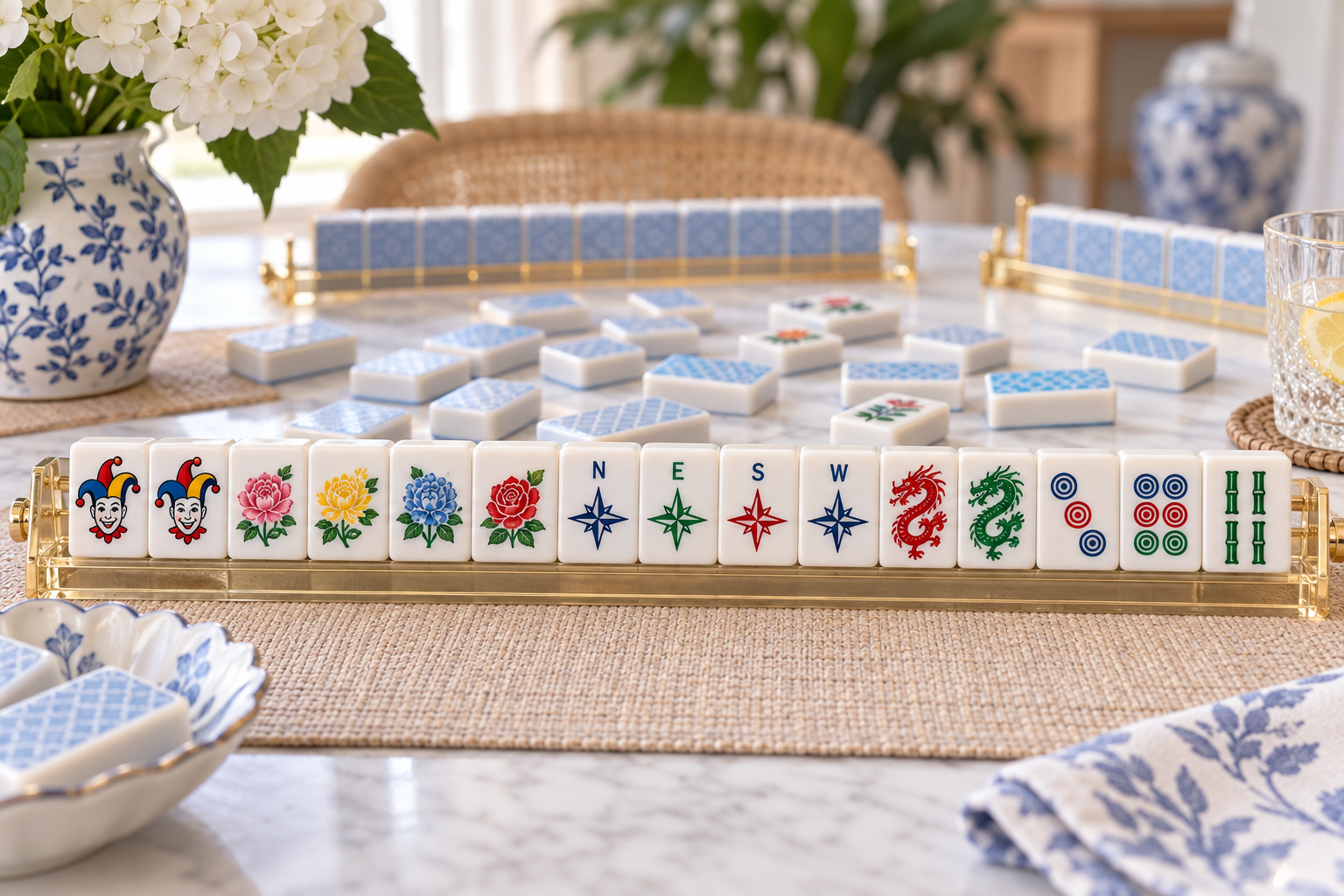
For retailers, distributors and private-label brands, understanding how to play mahjong is important when choosing products for your market.
Customers often search how to play mahjong before they decide which Mahjong set to buy. If a retailer understands the basic rules, tile types and accessories used during play, it becomes much easier to choose the right products, write clearer product descriptions and answer customer questions.
This guide explains how to play mahjong from a practical B2B perspective and highlights what wholesale buyers should consider when sourcing Mahjong sets for beginners.
What Is Mahjong?
Mahjong is a traditional tile-based game that is most commonly played by four players.
However, there is not just one universal version of the game. Popular variations include:
- Chinese Mahjong
- American Mahjong
- Hong Kong Mahjong
- Japanese Riichi Mahjong
- Taiwanese Mahjong
This matters for retailers because customers searching how to play mahjong may be looking for different rules depending on the style they want to learn.
A Mahjong set that works for one version may not always be suitable for another.
How Many Players Are Needed to Play Mahjong?
Most Mahjong games are designed for four players.
Each player normally receives a starting hand and takes turns drawing and discarding tiles.
Depending on the game variation, players may also use:
- Tile racks
- Dice
- Wind indicators
- Score markers
- Mahjong mats
- Reference cards
When explaining how to play mahjong to beginners, it is useful to show not only the tiles but also the accessories commonly used during a game.
For retailers, these accessories can also create additional product opportunities.
What Tiles Are Used in Mahjong?
Understanding the tile categories is one of the first steps in learning how to play mahjong.
Most Mahjong sets contain several groups of tiles.
Dots
Dots, sometimes called Circles, are numbered from 1 to 9.
Bamboo
Bamboo tiles are also numbered from 1 to 9 and may be called Bams in American Mahjong.
Characters
Character tiles are numbered from 1 to 9. In American Mahjong, these may be called Craks.
Winds
The four Wind tiles are:
East, South, West and North.
Dragons
Common Dragon tiles include:
Red Dragon, Green Dragon and White Dragon.
Flowers and Other Special Tiles
Depending on the Mahjong version, sets may also include:
- Flowers
- Seasons
- Jokers
- Blank tiles
This is especially important for B2B buyers because the correct tile configuration must match the target market.
How to Play Mahjong: The Basic Objective
The general objective of Mahjong is to build a winning hand by collecting specific combinations of tiles.
When beginners learn how to play mahjong, they usually start by understanding four basic types of combinations:
- Pung
- Kong
- Chow
- Pair
Different Mahjong versions may use different scoring systems and winning requirements, but these combinations are a useful starting point.
What Is a Pung?
A Pung is a group of three identical tiles.
For example:
Three identical 5 Bamboo tiles form a Pung.
Three identical East Wind tiles can also form a Pung.
This is one of the simplest combinations to understand when teaching someone how to play mahjong.
What Is a Kong?
A Kong consists of four identical tiles.
It is similar to a Pung but contains four matching tiles instead of three.
Different Mahjong rules may treat Kongs differently, so beginner instructions should always match the correct version of the game.
What Is a Chow?
A Chow is a sequence of three consecutive numbered tiles from the same suit.
For example:
3 Bamboo + 4 Bamboo + 5 Bamboo.
Chows normally cannot be made using Winds or Dragons.
Retailers publishing content about how to play mahjong should make these distinctions clear so beginners do not become confused.
What Is a Pair?
A Pair consists of two identical tiles.
In many traditional Mahjong variations, a winning hand includes several tile combinations plus one Pair.
This is another basic concept that beginners should understand before moving to more detailed rules.
How Does a Mahjong Game Start?
A traditional Mahjong game usually begins by shuffling the tiles face down.
Players then build walls of tiles around the table.
The starting player is often associated with East, although the exact setup depends on the Mahjong version.
Tiles are then distributed to each player.
From this point, players take turns drawing and discarding.
For people learning how to play mahjong, the basic pattern can be understood as:
Draw a tile → evaluate the hand → discard a tile → continue.
Drawing and Discarding Tiles
During a normal turn, a player draws one tile and then discards one tile.
The goal is to gradually improve the hand until it reaches a valid winning structure.
This draw-and-discard process continues throughout the round.
Customers who are learning how to play mahjong usually understand the game more easily once they become familiar with this basic rhythm.
For retailers, demonstrating this process through product photos, video or printed instructions can make a Mahjong set feel more beginner-friendly.
Can Players Use Discarded Tiles?
In many Mahjong variations, players may claim a tile discarded by another player.
A discarded tile may sometimes be used to complete:
- A Pung
- A Kong
- A Chow
- A winning hand
However, claiming rules differ between Mahjong versions.
This is why a retailer should avoid presenting one rule guide as suitable for every type of Mahjong.
Why Different Mahjong Versions Matter
One of the biggest mistakes beginners make when searching how to play mahjong is assuming that every Mahjong set uses exactly the same rules.
This is not the case.
For example, American Mahjong commonly uses:
- Jokers
- Tile racks
- An annual playing card
- Different hand structures
Chinese Mahjong usually follows a different format.
Japanese Riichi Mahjong has its own scoring rules and tile requirements.
For wholesale buyers, identifying the intended Mahjong version should happen before selecting a product.
What Makes a Mahjong Set Beginner-Friendly?
Customers who are still learning how to play mahjong usually benefit from clear, easy-to-read tiles.
Useful beginner features include:
- Clearly printed symbols
- Easy-to-read numbers
- Consistent tile dimensions
- High colour contrast
- Comfortable tile weight
- Clear English labels where appropriate
- Simple storage
- Basic instructions
A visually attractive Mahjong set is important, but readability should not be ignored.
Should Retailers Include Instructions?
Yes, especially when selling to beginners.
If customers are searching how to play mahjong, there is a good chance they are buying their first set.
Including a basic guide can improve the customer experience.
Retailers may consider adding:
- Quick-start instructions
- Tile identification guide
- Setup diagram
- Rule booklet
- QR code linking to a tutorial
- Game reference card
Private-label brands can also customise these materials to match their packaging.
Mahjong Accessories for Beginners
A complete Mahjong setup may include more than tiles.
Useful accessories include:
- Tile racks
- Mahjong mat
- Dice
- Carry case
- Storage trays
- Wind indicators
- Reference cards
Retailers targeting people learning how to play mahjong may find that bundles are easier for beginners to understand than selling every accessory separately.
For example, a beginner bundle might contain tiles, four racks, dice, a mat and a quick-start guide.
Why a Mahjong Mat Can Be Useful
A Mahjong mat can help reduce noise when tiles are shuffled and protect the table surface.
It can also make the playing area feel more organised.
For wholesale buyers, Mahjong mats can be sold:
- Separately
- With tile sets
- In premium bundles
- As private-label accessories
Customers researching how to play mahjong may not initially realise that a mat is useful, so educational content can also help introduce accessories.
How “How to Play Mahjong” Content Can Support Retail Sales
Educational content has value beyond teaching the rules.
A visitor searching how to play mahjong may still be deciding whether to buy a set.
A retailer can use beginner content to guide that visitor toward the right product.
Useful supporting content includes:
- Beginner Mahjong guides
- Mahjong tile explanations
- Mahjong set buying guides
- Mahjong accessory guides
- Differences between Mahjong versions
- Game-night setup guides
This creates a natural connection between informational searches and product discovery.
What Wholesale Buyers Should Check Before Ordering
Before ordering Mahjong products in bulk, buyers should confirm:
- Mahjong version
- Complete tile configuration
- Tile size
- Tile material
- Number of Jokers
- Number of Flowers
- Included accessories
- Rack quantity
- Packaging
- MOQ
- Customisation options
- Sample availability
This is particularly important when supplying customers who are learning how to play mahjong, because incorrect or incomplete products can create confusion.
Custom Mahjong Sets for Retail Brands
Private-label retailers may want a product that is visually different from standard wholesale sets.
Possible customisation options can include:
- Custom tile faces
- Custom tile backs
- Brand colours
- Logos
- Custom racks
- Mahjong mats
- Carry cases
- Retail packaging
- Instruction materials
Customisation is normally a paid service, and costs depend on artwork, materials, printing requirements, packaging and order quantity.
Final production artwork may need to be supplied in Adobe Illustrator .AI format.
Check Tile Accuracy Before Production
Mahjong products require careful quality control.
Before approving mass production, buyers should check:
- Correct tile quantities
- Correct symbols
- Correct numbers
- Correct Winds
- Correct Dragons
- Correct Jokers
- Correct colours
- Consistent dimensions
If customers are using the set while learning how to play mahjong, even small errors can make the game difficult to understand.
Approve a Physical Sample
For wholesale and private-label orders, a physical sample is strongly recommended before mass production.
Check:
- Tile print quality
- Colour accuracy
- Tile thickness
- Tile weight
- Surface finish
- Rack compatibility
- Packaging
- Accessories
A physical sample gives buyers a much better understanding of the final product than digital artwork alone.
Build a Beginner-Friendly Product Range
Retailers do not need to offer only one type of Mahjong set.
A simple range could include:
Entry-Level Set
Tiles, dice and basic storage.
Standard Set
Tiles, racks, dice and beginner instructions.
Premium Set
Tiles, racks, Mahjong mat, upgraded packaging and additional accessories.
Customers who already understand how to play mahjong may later upgrade to more decorative or premium products, while beginners may prefer complete starter bundles.
Final Thoughts
Understanding how to play mahjong helps wholesale buyers make better sourcing decisions.
It provides a clearer understanding of:
- Which tiles are required
- Which accessories are useful
- Why Mahjong versions matter
- What beginners need
- How products should be packaged
- What information should be included with a set
For retailers, distributors and private-label brands, how to play mahjong is not only an educational topic. It can also help connect beginner customers with the right Mahjong products.
A well-designed set with accurate tiles, clear instructions and appropriate accessories can make it easier for customers to learn the game and enjoy their first Mahjong experience.
About the Author
HUHU Team
We share industry insights, product knowledge, and manufacturing updates to help global clients better understand mahjong production and OEM solutions.