OEM/ODM MANUFACTURING FOR GLOBAL BRANDS
- View Our Alibaba Store
- info@huhumahjong.com
- +86 13326907761
Mahjong Product Labeling for Wholesale: Barcodes, SKUs and Retail Packaging
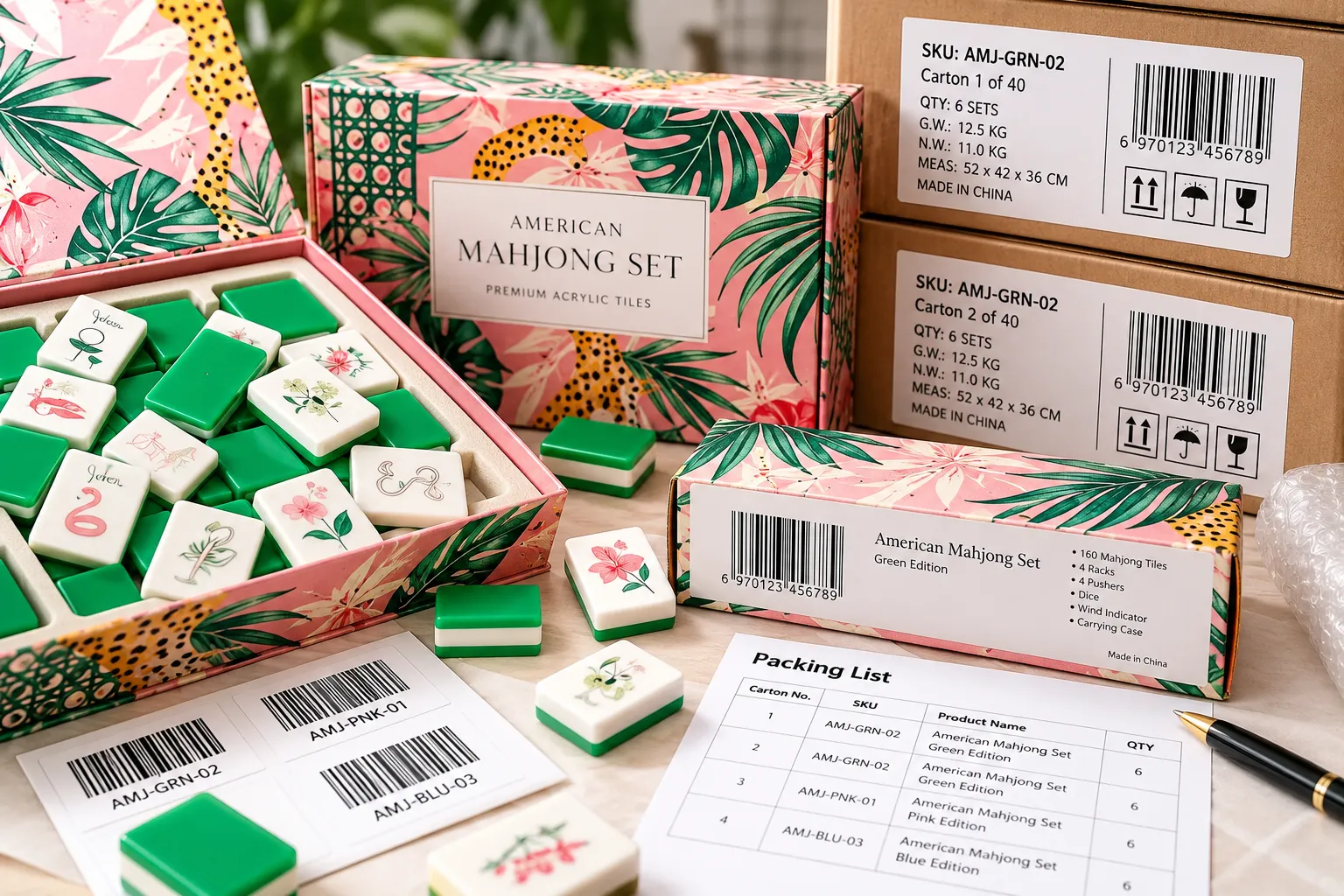
Mahjong product labeling is an important part of preparing a wholesale Mahjong set for retail.
For retailers, distributors and private-label brands, the product itself is only one part of the order. Before a Mahjong set can be stocked, shipped to a warehouse or sold through an online marketplace, the packaging may also need barcodes, SKUs, carton labels, product information and other retail markings.
Good Mahjong product labeling helps buyers organise inventory, reduce warehouse mistakes and prepare products for different sales channels.
This guide explains what wholesale buyers should consider before approving labels and retail packaging for a bulk Mahjong order.
Why Mahjong Product Labeling Matters
Professional retail operations need products to be easy to identify.
Clear Mahjong product labeling can help with:
- Inventory management
- Warehouse receiving
- Order fulfilment
- Marketplace listings
- Retail scanning
- Reorders
- Product tracking
Without clear labels, similar Mahjong sets can easily be confused.
This becomes especially important when a retailer carries multiple colours, designs or packaging versions.
1. Start With a Clear SKU System
A SKU is an internal product code used to identify a specific product.
For example:
MHJ-PINK-001
could represent a pink American Mahjong set.
Another SKU might be:
MHJ-BLUE-001
for the blue version.
A good SKU system makes Mahjong product labeling easier to manage as your collection grows.
2. Keep SKUs Short and Logical
A useful SKU should be:
- Easy to read
- Easy to type
- Unique
- Consistent
Avoid very long codes that employees cannot remember.
You might include:
- Product category
- Colour
- Design
- Version
For example:
AMJ-GRN-02
This could mean American Mahjong, green, design 02.
3. Understand UPC and EAN Barcodes
Retailers may need standard retail barcodes.
Common systems include:
- UPC
- EAN
These are different from internal SKUs.
A SKU is created by your own business.
A UPC or EAN is a standardised retail barcode used by many stores and marketplaces.
When planning Mahjong product labeling, buyers should decide whether the factory will print the barcode directly onto the packaging or apply a separate label.
4. Do Not Let the Factory Invent Your Barcode
Barcodes should come from the buyer or an authorised barcode system.
The supplier should not randomly create a retail barcode unless specifically instructed.
Before mass production, provide:
- Barcode number
- Barcode artwork
- Required dimensions
- Placement instructions
This reduces the risk of incorrect Mahjong product labeling.
5. Check Barcode Scannability
A barcode may look correct but still fail to scan.
Problems can occur because of:
- Low print quality
- Incorrect size
- Poor contrast
- Reflective packaging
- Distorted artwork
Before bulk production, test the barcode using an actual scanner or mobile scanning system where appropriate.
For retail-ready packaging, this is an important QC step.
6. Decide Where the Barcode Should Go
Common barcode locations include:
- Back of the box
- Bottom of the box
- Side panel
- Outer sleeve
The best location depends on packaging design.
For premium Mahjong sets, buyers often want the barcode placed discreetly so it does not interfere with the front presentation.
Good Mahjong product labeling should be functional without making the packaging look cluttered.
7. Add Product Name Clearly
Retail packaging should clearly identify the product.
For example:
American Mahjong Set – Pink Marble Edition
This is useful for:
- Customers
- Retail staff
- Warehouse teams
If several designs use similar packaging, the product name should be easy to find.
8. Add Colour or Variant Information
If one design comes in several colours, identify the variant.
For example:
- Pink
- Blue
- Green
- Pearl White
Variant information makes Mahjong product labeling more useful for warehouse receiving and fulfilment.
It also reduces the risk of customers receiving the wrong colour.
9. Consider Product Quantity Information
Packaging may also indicate what is included.
For example:
- 160 Mahjong tiles
- 4 racks
- 4 pushers
- Dice
- Wind indicator
- Carrying case
The exact contents should match the actual product.
Do not reuse an old label if the accessory configuration has changed.
10. Include Material Information Where Appropriate
Depending on the product and market, buyers may choose to show material information.
Examples include:
- Acrylic
- Melamine
- Resin
This can help customers understand the product.
For premium products, material details may also support retail positioning.
11. Country-of-Origin Marking
International buyers should check whether the destination market requires country-of-origin information.
Examples may include:
Made in China
or other required wording.
Requirements vary by destination.
Before confirming Mahjong product labeling, buyers should check local import and retail rules.
The manufacturer can print the required wording once the buyer confirms the specification.
12. Add Importer or Distributor Information if Required
Some markets may require information about the:
- Importer
- Distributor
- Responsible company
This may include:
- Company name
- Address
- Contact information
The exact requirement depends on the destination market.
Wholesale buyers should confirm this before packaging goes into production.
13. Warning Labels May Be Needed
Depending on:
- Product type
- Accessories
- Target age
- Destination market
certain warnings may be required.
For example, products containing small parts may need age-related or choking-hazard information in some markets.
Do not copy warning labels from another product without checking whether they apply.
Professional Mahjong product labeling should reflect the actual product and destination requirements.
14. Keep Packaging Information Consistent
All printed information should match across:
- Retail box
- Barcode
- Product listing
- Invoice
- Carton label
For example, if the product is called:
Blue Marble American Mahjong Set
that name should not become:
Blue Acrylic Mahjong Set
on another label unless this difference is intentional.
Consistency helps prevent inventory errors.
15. Master Carton Labels Are Different
Retail labels and master carton labels serve different purposes.
A master carton label may include:
- Product name
- SKU
- Quantity
- Carton number
- Gross weight
- Net weight
- Carton dimensions
- Destination
This is part of Mahjong product labeling for logistics rather than customer-facing retail.
16. Use Carton Numbers for Large Orders
For larger orders, carton numbering can help.
For example:
Carton 1 of 40
Carton 2 of 40
This makes it easier to check whether every carton has arrived.
It also simplifies warehouse receiving.
17. Mixed SKU Shipments Need Clear Labels
If one shipment contains several products, labels become even more important.
For example:
- Pink set
- Blue set
- Green set
- Premium set
Each carton should clearly show the correct SKU and quantity.
Good Mahjong product labeling reduces the risk of mixing products during packing or receiving.
18. Marketplace Labels May Be Different
If you sell through marketplaces, you may need additional labels.
Depending on the platform, this could include:
- Fulfilment labels
- Warehouse labels
- Seller barcodes
- Product identification labels
These requirements can differ from normal retail packaging.
Buyers should prepare these requirements before shipment whenever possible.
19. Avoid Placing Labels Over Important Design Areas
Temporary warehouse labels should not cover:
- Logos
- Product names
- Instructions
- Retail barcodes
- Legal information
If possible, create a designated label area on the packaging.
This keeps the final presentation cleaner.
20. Confirm Label Adhesive Quality
For sticker labels, adhesive matters.
Labels should not:
- Peel during shipping
- Curl at the corners
- Leave excessive residue
- Damage premium packaging
Ask the supplier to test the label on the final box material.
This is especially important for textured, matte or coated packaging.
21. Printed Labels vs Stickers
There are two common approaches.
Printed Directly on Packaging
Advantages:
- Cleaner appearance
- More premium
- No peeling
Disadvantages:
- Harder to change
- Requires final data earlier
Sticker Labels
Advantages:
- Flexible
- Easier to update
- Useful for different markets
Disadvantages:
- May look less premium
- Adhesive quality matters
The right Mahjong product labeling method depends on your order size and retail strategy.
22. Use Different Labels for Different Markets
One product may be sold in several countries.
Different markets may require different:
- Language
- Barcodes
- Importer details
- Compliance wording
Instead of printing all information directly on one box, some brands use a common retail package with market-specific stickers.
This can make international inventory more flexible.
23. Approve Label Artwork Before Production
Do not approve packaging without checking the final label files.
Review:
- SKU
- Barcode
- Product name
- Colour
- Company details
- Country of origin
- Quantity
- Required warnings
One wrong digit in a barcode or SKU can create problems across the entire shipment.
24. Include Labels in Sample Approval
If possible, the final sample should include the actual retail label.
This helps buyers check:
- Size
- Position
- Print quality
- Colour
- Scannability
Labels should be part of the approved production standard.
This supports better Mahjong product labeling consistency during bulk production.
25. Perform Final Label QC
Before shipment, QC should confirm:
- Correct label
- Correct SKU
- Correct barcode
- Correct product variant
- Correct carton quantity
- Correct carton number
For mixed orders, random checks should be performed across multiple cartons.
Mahjong Product Labeling Checklist
Before mass production, confirm:
- SKU
- Barcode
- Product name
- Variant name
- Product contents
- Material information
- Country-of-origin marking
- Importer information
- Warning labels
- Retail label placement
- Master carton labels
- Carton numbering
- Marketplace labels
A clear checklist can prevent expensive mistakes.
Common Labeling Mistakes
Wholesale buyers should avoid:
- Using duplicate SKUs
- Printing the wrong barcode
- Forgetting variant names
- Using outdated company information
- Missing carton quantities
- Mixing labels between products
- Approving packaging before final label data is ready
These errors are easy to prevent when Mahjong product labeling is planned before production.
Final Thoughts
Professional Mahjong product labeling helps connect manufacturing, logistics, inventory and retail.
A good label system should make it easy to identify:
- What the product is
- Which variant it is
- Where it belongs
- How it should be tracked
For wholesale buyers, barcodes, SKUs and carton labels should be confirmed before bulk production rather than added at the last minute.
Clear labeling can make warehouse receiving, fulfilment and repeat orders much easier.
Preparing a Retail-Ready Mahjong Product?
HUHU Mahjong supports retailers, distributors and brands with custom Mahjong sets, private-label packaging, barcode placement, carton labels and OEM production.
If you need support with Mahjong product labeling, send us your SKU, barcode, packaging and order requirements.
About the Author
HUHU Team
We share industry insights, product knowledge, and manufacturing updates to help global clients better understand mahjong production and OEM solutions.