OEM/ODM MANUFACTURING FOR GLOBAL BRANDS
- View Our Alibaba Store
- info@huhumahjong.com
- +86 13326907761
FOB vs CIF vs DDP for Mahjong Wholesale Orders: Which Shipping Term Should You Choose?
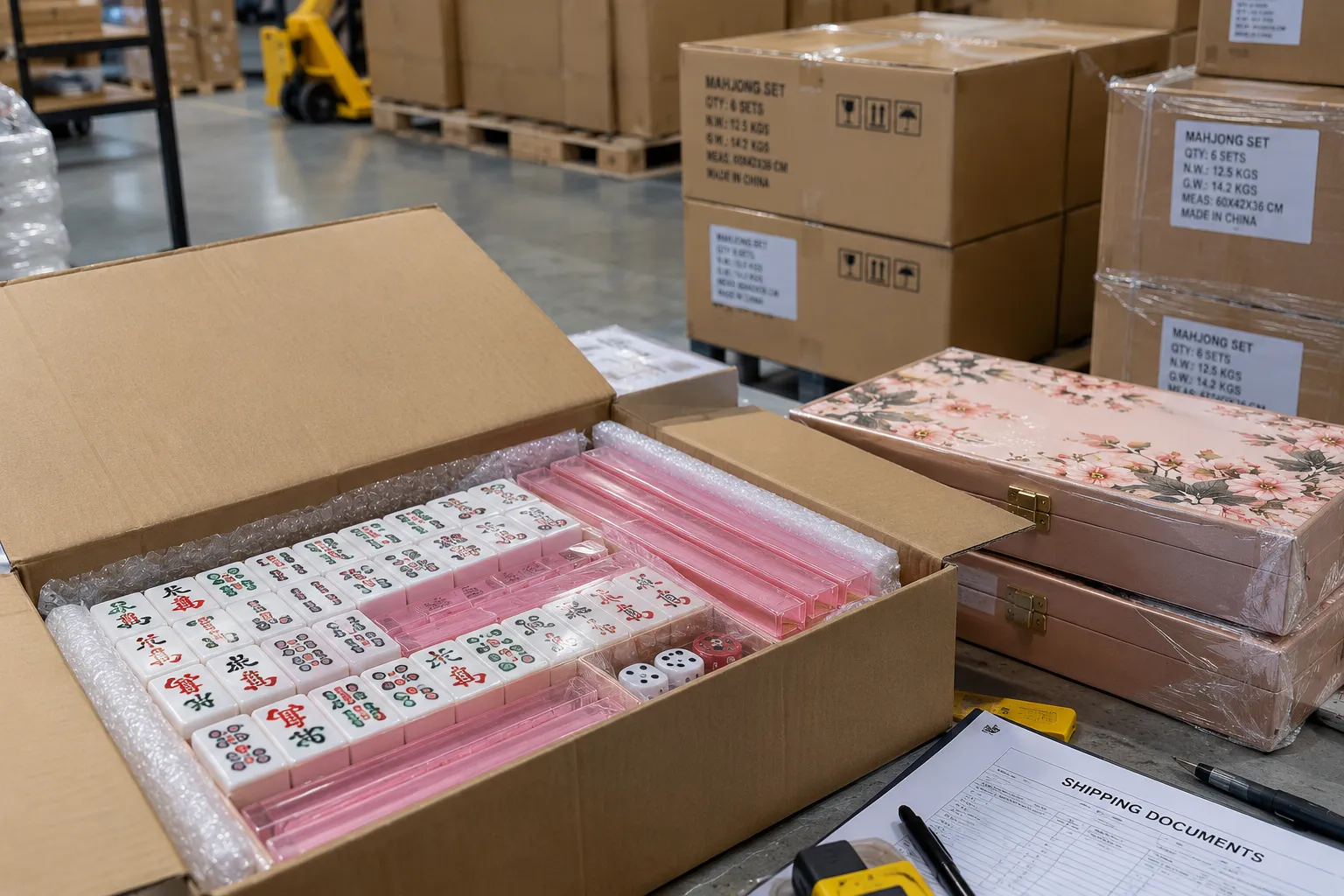
FOB vs CIF is one of the first questions every wholesale buyer faces when requesting a quotation. Two suppliers can quote the same mahjong set at the same price, and yet one quote may include freight and insurance while the other stops at the port. If you do not understand the difference, you can end up comparing numbers that were never meant to be compared.
This guide explains FOB vs CIF vs DDP in plain language, with a focus on mahjong wholesale and private-label orders. You will learn what each term covers, where risk transfers, how the choice affects your landed cost and how to ask for a quotation that leaves no surprises.
Why Shipping Terms Matter in Mahjong Wholesale Orders
A mahjong order passes through many hands: the factory, the export port, the carrier, the destination port, customs, a trucker and finally your warehouse. A shipping term, also called an Incoterm, answers three practical questions:
- Who pays for each stage of the journey?
- Who arranges transport, insurance and customs clearance?
- Who carries the risk if the goods are lost or damaged along the way?
Getting these answers wrong can lead to unexpected bills, delayed clearance or disputes with your supplier. Choosing the right term is part of good wholesale order planning.
What Are Incoterms?
Incoterms are standard trade terms published by the International Chamber of Commerce (ICC). The current edition is Incoterms 2020, which contains eleven rules. They define the responsibilities of the seller and the buyer for delivery, cost and risk in international trade.
Two points are worth remembering:
- Incoterms cover delivery, costs and risk. They do not cover ownership, payment terms or quality disputes.
- Some terms, including FOB and CIF, are designed for sea and inland waterway transport only. For containerized cargo, the ICC and many trade advisers suggest related terms such as FCA and CIP, because the goods are normally handed over at a terminal rather than on board the ship.
Many suppliers still use FOB and CIF in everyday quotations, and these remain the most common terms in China export trade. If you want to use a different term, discuss it with your supplier before the quotation is finalized.
FOB vs CIF: The Core Difference
The simplest way to remember FOB vs CIF is this: under FOB, you arrange and pay for the main shipping. Under CIF, the seller arranges and pays for the main shipping and basic insurance up to your destination port.
FOB (Free On Board)
Under FOB, the seller delivers the goods on board the vessel at the named port of shipment, for example a Chinese export port. The seller handles the Chinese side: packing, loading and export clearance.
From the moment the goods are on board, the buyer takes over:
- Ocean or air freight to the destination
- Cargo insurance (if you choose to buy it, and you should)
- Import customs clearance, duties and taxes
- Port handling at the destination
- Delivery to your warehouse
Because you choose the carrier or forwarder, FOB gives you more control over cost and schedule. It suits buyers who already work with a freight forwarder, ship regularly or want to compare freight rates.
CIF (Cost, Insurance and Freight)
Under CIF, the seller arranges and pays for the ocean freight and a minimum level of marine insurance to the named destination port. The price you see already includes those two items.
You are still responsible for:
- Unloading and port charges at the destination (depending on the contract)
- Import customs clearance, duties and taxes
- Inland delivery to your warehouse
CIF is simpler for many first-time buyers, because the supplier coordinates the sailing and gives you one price up to your destination port.
An important detail about risk
Here is the part many buyers miss. Under both FOB and CIF, risk passes to the buyer once the goods are loaded on the vessel, even though under CIF the seller has paid for the freight and insurance. In other words, if something goes wrong at sea, you are the one who must claim against the insurance policy.
Another detail: the insurance required under CIF is only a minimum level of cover. It protects against a limited list of events and is typically valued at 110% of the contract price. For a high-value or fragile shipment, many buyers prefer to arrange broader cover themselves.
DDP: Delivered Duty Paid
DDP is at the opposite end of the scale. Under DDP, the seller takes responsibility for almost everything: export clearance, main carriage, insurance, import clearance, duties, taxes and delivery to your named location. You receive a single price and goods delivered to your door.
The attractions are clear:
- Simplicity, especially for small or first-time orders
- One price, with fewer moving parts to manage
- Less paperwork for the buyer
But DDP has trade-offs you should understand:
- The price is higher, because the seller bundles freight, duties, insurance and handling costs, plus a margin for the risk.
- You have less visibility into each cost component, which makes comparing quotes harder.
- Customs responsibility still matters. Even when the seller files the import entry, the importer of record can remain responsible for the accuracy of the declaration, so values and product descriptions must be correct.
- Not every supplier offers DDP, and it depends on the destination country.
If you want the seller to deliver to your door but prefer to handle import customs yourself, a related term called DAP (Delivered at Place) may fit better. Ask your supplier what is available for your destination.
Other Terms You May Hear
You may come across a few more terms during negotiation:
- EXW (Ex Works): the seller makes the goods available at the factory, and the buyer arranges everything else, including export clearance in China. It is the minimum obligation for the seller and can be complicated for overseas buyers.
- FCA (Free Carrier): the seller hands the goods to a carrier named by the buyer. It is widely recommended for container shipments.
- CIP (Carriage and Insurance Paid To): similar to CIF but suitable for containers, with broader insurance cover under the 2020 rules.
- DAP (Delivered at Place): the seller delivers to a named destination, and the buyer handles import clearance and duties.
For most mahjong buyers, FOB vs CIF is the practical comparison, with DDP as an option for smaller orders.
FOB vs CIF for Mahjong: Which Fits Your Business?
There is no single correct answer. Use these guidelines as a starting point.
FOB may suit you if:
- You have a trusted freight forwarder and customs broker
- You place regular or larger orders and want to compare freight rates
- You want control over carrier choice, sailing dates and insurance
- You prefer to see each cost separately
CIF may suit you if:
- You are new to importing and want a simpler quotation
- Your supplier can offer competitive freight through its own partners
- You do not yet have a forwarder
- You want one price to your destination port
DDP may suit you if:
- Your order is small or a one-time purchase
- You want door-to-door delivery with minimal involvement
- You are comfortable with a higher, all-inclusive price
Whichever you choose, remember that duties, taxes and inland delivery are still part of your total cost unless the quotation states otherwise. Our guide to calculating American mahjong landed cost shows how to add everything up.
What FOB vs CIF Means for Your Total Landed Cost
A fair comparison always uses the same endpoint. When you compare FOB vs CIF quotes, convert both into the full cost delivered to your warehouse. A simple way to do that:
- Start with the product price at the stated term.
- Add freight, if it is not included (FOB).
- Add insurance, including any upgrade beyond the minimum.
- Add destination charges, such as port handling, documentation and terminal fees.
- Add duties and taxes, based on the correct customs classification and declared value.
- Add customs broker fees and inland transport.
- Add inspection, labeling or prep costs if relevant.
A low FOB price can look attractive until you add freight and fees, while a CIF price can look expensive until you realize it already contains transport. The only fair comparison is landed cost.
Insurance: Do Not Rely on the Minimum
Mahjong sets contain fragile finishes, glossy surfaces and precisely fitted components. A damaged carton can mean damaged tiles, cracked racks and a delayed sales season.
Whichever term you choose:
- Confirm who buys insurance and at what level of cover.
- Check what the policy covers, including breakage, water damage and theft.
- Insure the full value, including freight, so a claim covers your real loss.
- Keep photos and inspection reports from before shipment, which support any claim.
Strong packaging also reduces risk. Our guide to mahjong carton packing for wholesale orders explains how to protect goods in transit.
Samples and Small Orders: Express vs Freight
Shipping terms matter for samples too, though the logistics differ. For samples and small orders, express carriers such as DHL, UPS and FedEx are common, with delivery usually in a matter of days. For bulk orders, sea freight and air freight are the usual options, and sea is normally the most economical for larger volumes.
When you request samples, ask who pays for shipping and whether duties apply. Our sample approval guide explains how to handle this stage before you place a bulk order.
Cartons, Weight and Shipping Terms
Your shipping term does not change how cartons are packed, but it does determine who is responsible when they are handled by carriers. Make sure the following are agreed before production:
- Carton size and weight, so cartons fit the container and can be lifted safely
- Number of sets per carton and the total number of cartons
- Shipping marks and labels, including your PO number and destination details
- Barcode and SKU labeling, if required by your retailer or marketplace
See our guide to mahjong product labeling for wholesale for help with retail labels and barcodes.
Documents You Will Need
The exact set depends on your destination and shipping term, but a typical mahjong wholesale shipment uses:
- Proforma invoice (PI), confirming the order and the agreed shipping term
- Commercial invoice, used for customs clearance and valuation
- Packing list, describing cartons, quantities and weights
- Bill of lading or air waybill, the carrier’s receipt and contract of carriage
- Certificate of origin, where your country requires one
- Insurance certificate, if insurance is included
Make sure your product descriptions, quantities and values are accurate and consistent across all documents. Mismatches are a common reason for customs delays. Our mahjong purchase order guide helps you build a clean order from the start.
Common Mistakes With FOB vs CIF
Avoid these frequent problems:
- Comparing quotes under different terms as if they were the same
- Forgetting the named port. FOB Shenzhen and FOB Shanghai are not the same, and CIF to your port differs from CIF to another.
- Assuming CIF means the seller is responsible for the goods until delivery. Risk usually passes at loading.
- Relying on minimum insurance for valuable cargo
- Choosing FOB without a forwarder or broker, then scrambling after the goods are ready
- Ignoring destination costs, such as port fees, duties and inland delivery
- Under-declaring value to lower duties, which is illegal and can bring serious penalties
- Not putting the term in writing, including the named port and the Incoterms edition
How to Request a Clear Quotation
To avoid confusion, include these details in your inquiry and ask for them in the reply:
- Product details: style, materials, tile size, packaging and quantity
- Shipping term: FOB, CIF or another term, with the named port
- Destination: country, port and, if needed, final delivery address
- Shipping method: sea, air or express
- Insurance: who arranges it and at what level
- Lead time: production time and shipping time, in writing
- Documents: which documents will be provided
- Validity: how long the quotation remains valid
Our guide on how to prepare a first bulk mahjong order walks through the other details to confirm before you pay a deposit.
How Huhu Mahjong Quotes and Ships
Huhu Mahjong is a factory-direct OEM, ODM and OBM manufacturer with more than 12 years of mahjong experience. We support FOB and CIF terms, use DHL, UPS and FedEx for samples and small orders, and offer sea and air freight for bulk orders. Export documents are provided, and every order goes through 100% pre-shipment inspection with QC reports available.
If you are comparing FOB vs CIF, tell us your destination, order size and any freight forwarder you already use, and we will quote in the structure that suits you. If you need a different arrangement, such as door delivery, ask our team what is possible for your market. You can learn more about our process on the Production Process page or see our FAQ, and when you are ready, contact us for a quotation.
Frequently Asked Questions
What is the difference between FOB and CIF?
Under FOB, the seller delivers the goods on board the ship at the port of shipment, and the buyer arranges and pays for freight and insurance. Under CIF, the seller arranges and pays for freight and minimum insurance to your destination port. In both cases, risk passes to the buyer once the goods are loaded.
Is FOB or CIF better for mahjong wholesale?
It depends on your experience. FOB suits buyers with a forwarder who want control and transparent costs, while CIF is simpler for newer importers who want one price to the destination port.
Does CIF include import duties?
No. CIF includes freight and minimum insurance to the destination port. Import duties, taxes, customs clearance and inland delivery are normally the buyer’s responsibility unless the quotation says otherwise.
What does DDP mean for mahjong orders?
DDP means the seller delivers the goods to your named location with duties and taxes paid. It is simple for the buyer, but the price is usually higher, and accurate customs declarations still matter.
Should I buy extra insurance under CIF?
Often yes. CIF requires only a minimum level of cover, so many buyers arrange broader insurance for valuable or fragile cargo.
Can I ship mahjong sets by air?
Yes. Air freight and express are available for urgent or smaller orders, though sea freight is normally the most economical option for bulk volumes.
Final Thoughts
FOB vs CIF is not just a pricing question. It decides who controls the shipment, who pays for each stage and who handles problems when they arise. For many experienced buyers, FOB offers control and cost transparency. For newer buyers, CIF offers a simpler path to the destination port, and DDP offers door-to-door convenience at a higher price. Whatever you choose, compare quotes on a landed-cost basis, insure properly and put every detail in writing.
Ready to request a quotation? Send your product requirements, destination and preferred shipping term to our team, and we will reply within 24 hours with pricing and shipping options.
Note: Incoterms, customs rules, duties and shipping costs vary by country and change over time. This article is general information, not legal or customs advice. Please confirm requirements with your customs broker or forwarder.
Sources: Timewell – Incoterms 2020 beginner’s guide · Taylor Wessing – 10 to-dos for users of Incoterms 2020 · Project Materials – Incoterms 2020: EXW, FOB, CIF risks explained · Redstone GCI – Incoterms 2020: what are they and what’s new · Conventus Law – Incoterms 2020: the most important changes · Global Sources – DDP vs FOB · Cosmo Sourcing – FOB vs DDP: which Incoterm should you use · Trade Finance Global – Incoterms, VAT and importer of record
About the Author
HUHU Team
We share industry insights, product knowledge, and manufacturing updates to help global clients better understand mahjong production and OEM solutions.