
OEM/ODM MANUFACTURING FOR GLOBAL BRANDS
- View Our Alibaba Store
- info@huhumahjong.com
- +86 13326907761
How to Calculate the True Landed Cost of a Mahjong Wholesale Order
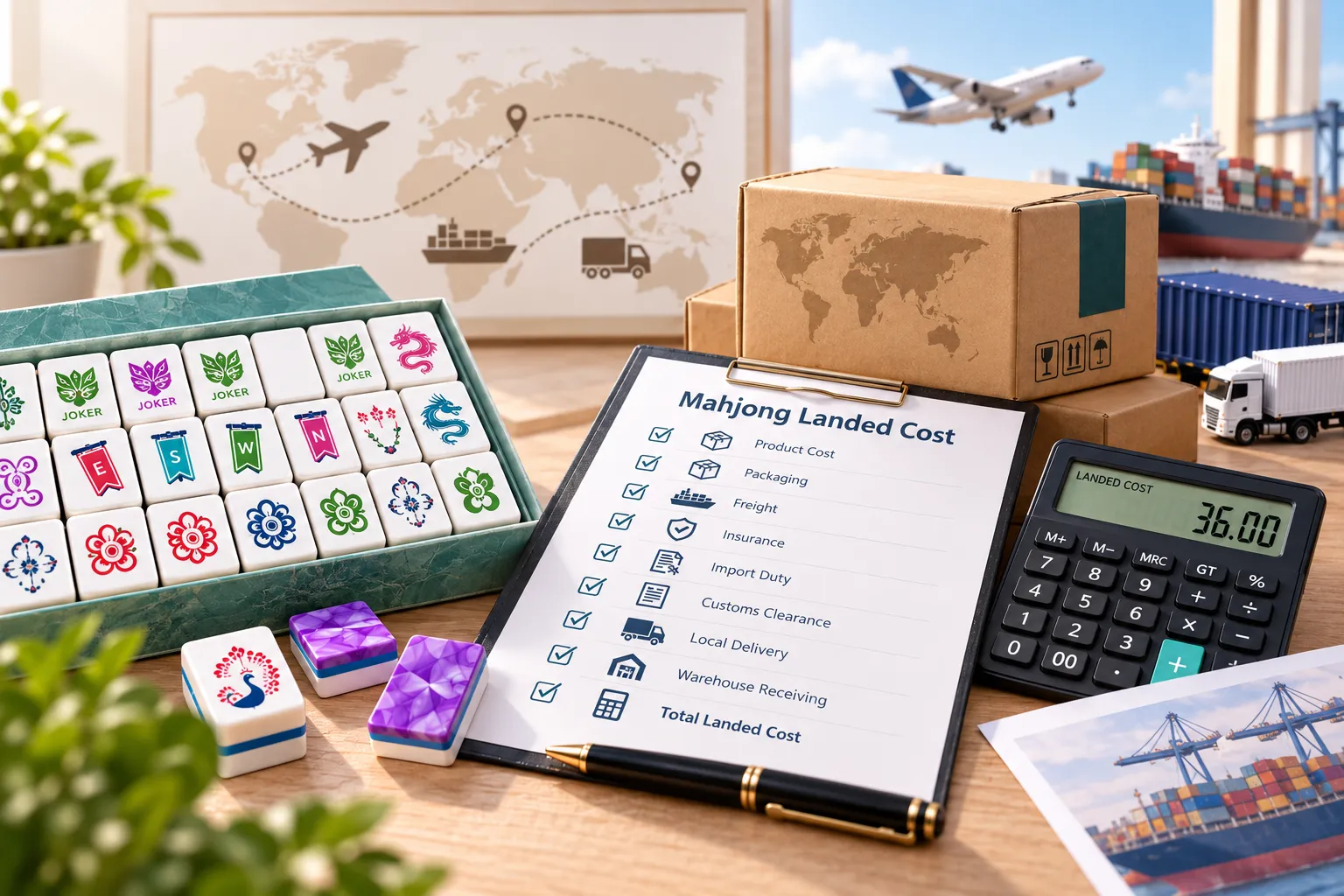
The wholesale unit price is only one part of the real cost of importing Mahjong products.
For retailers, distributors and private-label brands, understanding Mahjong Landed Cost is important because it shows how much each product actually costs by the time it reaches your warehouse.
Without calculating the full landed cost, a product may appear profitable at first but leave much less margin after freight, duties and handling expenses are included.
This guide explains the main costs buyers should include before deciding whether a wholesale Mahjong order makes financial sense.
What Is Mahjong Landed Cost?
Mahjong Landed Cost is the total cost of getting a Mahjong product from the supplier to your final receiving location.
It may include:
- Product cost
- Packaging
- Freight
- Insurance
- Export charges
- Import duty
- Customs clearance
- Port or airport fees
- Local delivery
- Warehouse receiving
The goal is to calculate the real cost per set, not only the supplier’s unit price.
1. Start With the Product Cost
Begin with the basic wholesale price.
For example:
500 Mahjong sets at $24 per set
Total product cost:
$12,000
This is your starting point, but it is not yet the final Mahjong Landed Cost.
2. Add Custom Packaging Costs
If you are using custom packaging, include any additional cost for:
- Retail boxes
- Gift boxes
- Printed inserts
- Storage cases
- Branded labels
- Protective trays
For example, if custom packaging adds $2 per set:
500 × $2 = $1,000
The product and packaging cost is now:
$13,000
3. Include Sample and Development Costs
For custom products, you may also have paid for:
- Samples
- Artwork setup
- Moulds
- Colour matching
- Packaging prototypes
Some buyers treat these as one-time development expenses.
Others spread the cost across the first order.
If a $500 development cost is spread across 500 sets, that adds:
$1 per set
This should be considered when calculating the first-order Mahjong Landed Cost.
4. Add International Freight
Freight is often one of the largest additional costs.
Shipping may be by:
- Express courier
- Air freight
- Sea freight
Freight cost depends on:
- Total weight
- Carton volume
- Destination
- Shipping method
- Season
- Fuel charges
For example:
Sea freight and related shipping charges: $2,500
This cost needs to be divided across the products in the shipment.
5. Understand Volumetric Weight
For air freight and courier shipments, cost may be calculated using actual weight or volumetric weight.
Large packaging can increase shipping cost even if the product itself is not extremely heavy.
This is why packaging design can directly affect Mahjong Landed Cost.
Compact packaging may reduce:
- Freight cost
- Storage space
- Fulfilment cost
6. Include Export Charges
Depending on the trade term, there may be costs before the shipment leaves the supplier’s country.
These may include:
- Export documentation
- Local transport
- Port handling
- Customs declaration
If your supplier quotes FOB, some of these charges may already be included.
If the quote is EXW, more costs may be the buyer’s responsibility.
7. Check the Shipping Term
Always confirm whether the quotation is:
- EXW
- FOB
- CIF
- DDP
- Another agreed term
These terms affect what is included in the supplier’s price.
A low EXW price may look attractive, but the final Mahjong Landed Cost may be higher after local logistics and export charges are added.
8. Add Cargo Insurance
Insurance may be a small percentage of the shipment value, but it should still be included.
Cargo insurance can help protect against:
- Loss
- Damage
- Certain transportation risks
For larger wholesale orders, this can be a sensible part of the overall logistics cost.
9. Calculate Import Duty
Import duty depends on:
- Destination country
- Product classification
- Declared value
- Tariff rate
The duty rate can vary by market.
Wholesale buyers should confirm the correct customs classification rather than guessing.
Import duty can significantly affect Mahjong Landed Cost on larger orders.
10. Include Import Taxes Where Applicable
Depending on the country, imports may also be subject to:
- VAT
- GST
- Sales-related import taxes
Some businesses may later reclaim certain taxes, depending on local rules and their tax registration.
Because this varies by country, buyers should check with a customs broker or tax professional.
11. Add Customs Clearance Fees
Customs clearance may involve:
- Broker fees
- Documentation fees
- Entry fees
- Inspection charges
Even if the shipment clears smoothly, there is often still a service fee.
These charges should be included in your calculation.
12. Include Port or Airport Fees
Some shipments may generate additional destination charges.
Examples include:
- Terminal handling
- Port fees
- Airport handling
- Documentation fees
- Storage charges
These can be especially important for sea freight shipments.
13. Add Local Delivery
After customs clearance, the goods still need to reach your:
- Warehouse
- Fulfilment centre
- Retail location
This final transport stage should be included in Mahjong Landed Cost.
A shipment is not truly landed until it reaches the location where you can begin selling or distributing it.
14. Include Warehouse Receiving Fees
Third-party warehouses may charge for:
- Receiving cartons
- Counting units
- Pallet handling
- Barcode scanning
- Inventory setup
For example, if warehouse receiving costs $400 for the shipment, that should be divided across the total units.
15. Include Relabelling or Preparation Costs
Sometimes products need additional work after import.
This may include:
- Applying barcodes
- Adding retail labels
- Repacking
- Bundling accessories
- Adding inserts
If this is required before the product can be sold, it forms part of the effective Mahjong Landed Cost.
16. Calculate the Total Shipment Cost
Imagine the order looks like this:
Product cost: $12,000
Custom packaging: $1,000
Development cost: $500
Freight: $2,500
Duty and clearance: $1,200
Local delivery: $500
Warehouse receiving: $300
Total:
$18,000
If the shipment contains 500 sets:
$18,000 ÷ 500 = $36 per set
Your true landed cost is therefore approximately:
$36 per Mahjong set
not the original $24 supplier price.
17. Compare Landed Cost With Retail Price
Once you know the Mahjong Landed Cost, compare it with your planned retail price.
For example:
Landed cost: $36
Retail price: $89
Gross amount remaining before other operating expenses:
$53
You still need to consider:
- Payment processing
- Fulfilment
- Customer shipping
- Advertising
- Returns
- Discounts
This helps you understand whether the product can support a healthy retail margin.
18. Calculate Landed Cost Before Increasing Quantity
Larger orders may reduce the product unit price.
They may also:
- Reduce freight cost per unit
- Increase storage costs
- Tie up more cash
Do not increase quantity only because the supplier offers a lower price.
Compare the full Mahjong Landed Cost at different order sizes.
19. Compare Shipping Methods
Sometimes a higher freight rate can still make business sense.
For example, air freight may cost more than sea freight, but it may help you:
- Launch earlier
- Avoid stockouts
- Meet seasonal demand
The cheapest logistics option is not always the most profitable overall choice.
20. Watch for Hidden Charges
When reviewing a quotation, ask whether there may be additional costs for:
- Packaging
- Export handling
- Pallets
- Documentation
- Customs
- Delivery appointments
Unexpected fees can quickly increase the final Mahjong Landed Cost.
21. Track Actual Cost After Delivery
Your first estimate may not exactly match the final cost.
After the shipment arrives, record the actual amounts paid for:
- Freight
- Duty
- Customs
- Delivery
- Warehouse receiving
This gives you a more accurate cost for future orders.
22. Use Previous Shipments to Improve Reorders
Once you have imported the same product before, future calculations become easier.
You can compare:
- Previous freight
- Previous duty
- Warehouse costs
- Carton volume
- Final cost per unit
Historical data can make reorder planning much more reliable.
Mahjong Landed Cost Checklist
Before placing a wholesale order, include:
- Unit product cost
- Custom packaging
- Sample or development cost
- Freight
- Insurance
- Export charges
- Import duty
- Import taxes
- Customs clearance
- Port or airport charges
- Local delivery
- Warehouse receiving
- Relabelling or preparation
A complete Mahjong Landed Cost calculation gives a much clearer view of the real investment required.
Working With HUHU Mahjong
HUHU Mahjong works with wholesalers, retailers, distributors and private-label brands purchasing Mahjong products for international markets.
Buyers can confirm product quantity, packaging, carton details and shipping requirements before placing an order.
Having accurate product and carton information can help buyers estimate Mahjong Landed Cost more effectively before the shipment begins.
Final Thoughts
Wholesale product price and true product cost are not the same thing.
A reliable Mahjong Landed Cost calculation should include every expense required to bring the product from the supplier to your warehouse.
This gives buyers a better basis for:
- Retail pricing
- Margin planning
- Shipping decisions
- Order quantity
- Cash-flow planning
Knowing the real cost before placing an order can help wholesalers make more confident purchasing decisions and avoid unpleasant surprises after the goods arrive.
About the Author
HUHU Team
We share industry insights, product knowledge, and manufacturing updates to help global clients better understand mahjong production and OEM solutions.