OEM/ODM MANUFACTURING FOR GLOBAL BRANDS
- View Our Alibaba Store
- info@huhumahjong.com
- +86 13326907761
Mahjong Packaging Guide for Wholesale Buyers
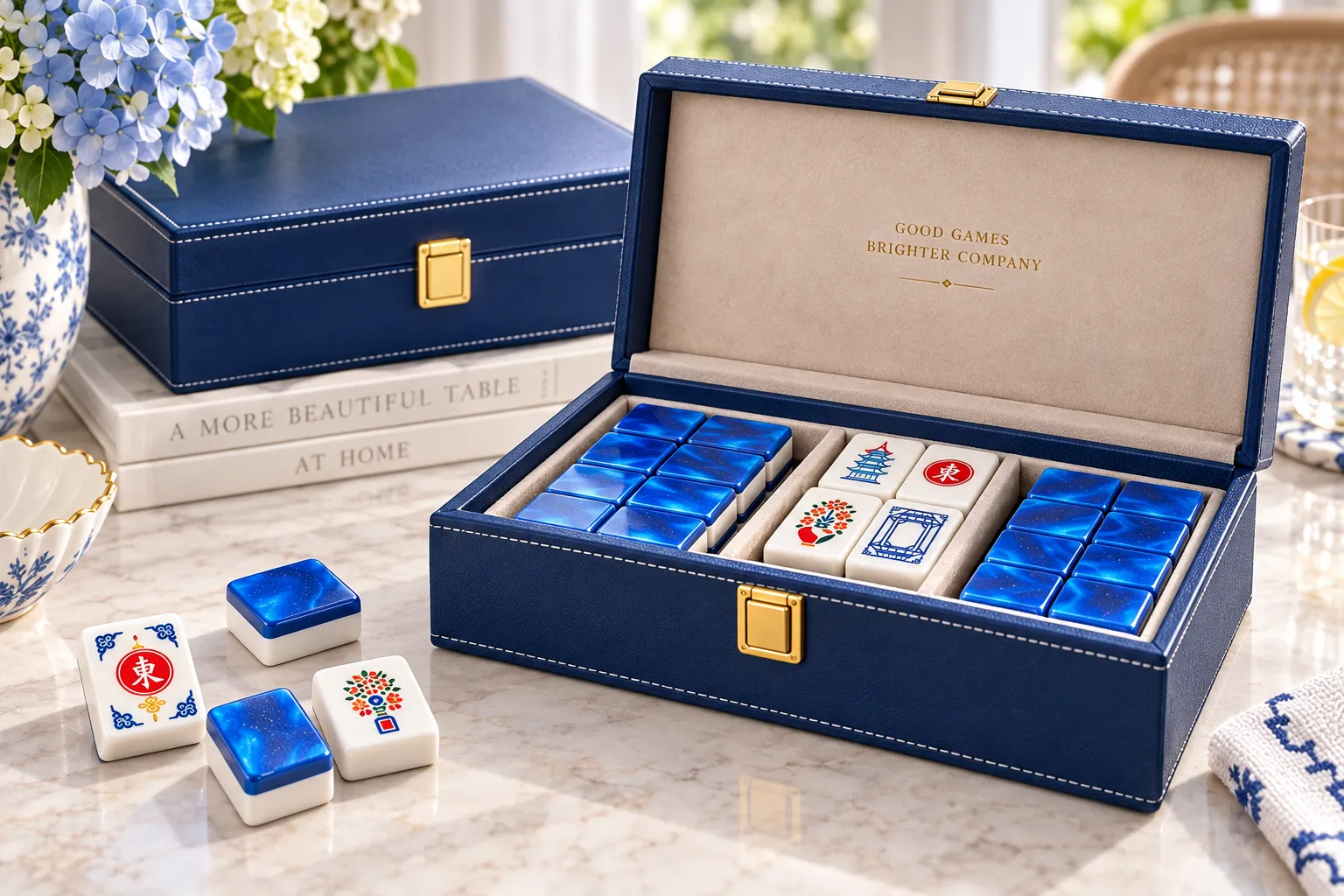
For retailers, distributors and private-label brands, choosing the right mahjong packaging is an important part of building a complete Mahjong product.
Packaging does more than protect the tiles. It affects shipping cost, storage, retail presentation, customer experience and brand positioning.
This guide explains what B2B buyers should consider when selecting mahjong packaging for wholesale and private-label orders.
Why Mahjong Packaging Matters
The right mahjong packaging can help:
- Protect tiles during shipping
- Keep accessories organised
- Improve retail presentation
- Support private-label branding
- Reduce product movement inside the box
- Control shipping volume
- Improve the unboxing experience
For wholesale buyers, packaging should be planned together with the Mahjong set rather than treated as an afterthought.
1. Start With the Product Configuration
Before choosing mahjong packaging, confirm exactly what needs to fit inside.
A Mahjong product may include:
- Mahjong tiles
- Tile racks
- Pushers
- Dice
- Wind indicators
- Mahjong mat
- Rule booklet
- Reference cards
- Storage trays
A set containing only tiles requires very different packaging from a premium American Mahjong set with four racks and accessories.
2. Confirm Tile Size Before Designing the Box
Tile dimensions directly affect the size of the packaging.
Buyers should confirm:
- Tile height
- Tile width
- Tile thickness
- Total tile quantity
A larger tile set may require:
- Bigger trays
- Wider cases
- Stronger inserts
- Larger master cartons
For this reason, mahjong packaging should normally be finalised after the tile dimensions are confirmed.
3. Consider the Total Set Weight
Mahjong sets can be relatively heavy.
The packaging needs enough strength to support:
- Tile weight
- Racks
- Accessories
- Internal trays
A decorative box may look attractive but still be unsuitable if it is not strong enough.
Wholesale buyers should test the complete packed product, not only the empty box.
4. Choose the Right Packaging Type
There are several common mahjong packaging options.
Cardboard Retail Box
Suitable for:
- Entry-level products
- Ecommerce
- Standard wholesale sets
Advantages may include:
- Lower cost
- Easy printing
- Lightweight construction
- Efficient storage
Carry Case
Suitable for:
- Mid-range products
- American Mahjong sets
- Travel-friendly products
Possible materials include:
- Fabric
- PU leather
- Hard shell
Wooden Box
Suitable for premium products.
Wooden packaging can create a more luxurious presentation but may increase:
- Product weight
- Shipping volume
- Cost
Drawstring or Fabric Bag
Useful for compact products or accessories.
A fabric bag may also be included inside a larger box.
5. Think About Retail Positioning
The mahjong packaging should match the product’s expected retail price.
For example:
Entry-Level
Simple printed box with practical inserts.
Mid-Range
Structured carry case with organised compartments.
Premium
Rigid box, premium carry case or wooden presentation box.
Using overly expensive packaging on an entry-level product can make the landed cost difficult to control.
6. Use Internal Trays to Protect the Tiles
Internal trays help stop tiles from moving during transportation.
A good tray should:
- Hold tiles securely
- Be easy to remove
- Fit the box properly
- Avoid putting too much pressure on the tiles
The tray layout should also make unpacking and repacking easy for customers.
7. Separate Tiles From Hard Accessories
If dice, racks or metal accessories move freely inside the package, they can scratch the tiles.
Good mahjong packaging should separate different components.
Possible solutions include:
- Dividers
- Small accessory compartments
- Fabric pouches
- Separate trays
This becomes especially important for glossy or decorative tiles.
8. Protect Decorative Tile Backs
Some Mahjong tiles use:
- Acrylic backs
- Transparent backs
- Marbled effects
- Printed patterns
- Multi-layer construction
These surfaces may require additional protection.
Avoid packaging designs that allow hard components to rub directly against decorative tile backs.
9. Check Rack Storage
American Mahjong sets often include four racks.
Racks can take up a large amount of packaging space.
Before finalising mahjong packaging, check:
- Rack length
- Rack height
- Pusher storage
- Whether racks can stack
- Whether racks need individual protection
A well-designed case can reduce wasted space.
10. Consider Pusher Storage
Pushers should not be placed loosely inside the box.
They may:
- Scratch tiles
- Bend
- Detach
- Move during shipping
Use a dedicated compartment or secure them with the racks.
11. Think About the Mahjong Mat
If the product includes a Mahjong mat, decide whether it will be:
- Rolled
- Folded
- Packed separately
- Placed inside the main set
The mat can significantly affect the size of the mahjong packaging.
A rolled mat may reduce fold lines but increase carton length.
12. Keep Printed Materials Flat
Rule booklets, reference cards and playing cards should have a dedicated flat area.
Avoid placing heavy tiles directly on top of them if possible.
Printed materials can become:
- Creased
- Bent
- Damaged
A document sleeve or flat compartment can help.
13. Plan Custom Branding
Private-label mahjong packaging may include:
- Brand logo
- Product name
- Brand colours
- Product photography
- Pattern design
- Care instructions
- Barcode
- Country-of-origin information
Branding should be planned early so there is enough space for both visual design and required product information.
14. Keep Branding Consistent
If the tiles, racks and case are customised, the packaging should follow the same visual direction.
Keep consistent:
- Colours
- Fonts
- Logo placement
- Pattern style
- Product naming
A coordinated product usually feels more premium than several unrelated design elements.
15. Prepare Packaging Artwork Correctly
For custom production, final packaging artwork may need to be supplied in Adobe Illustrator .AI format.
Artwork should clearly include:
- Dieline
- Bleed
- Safe area
- Cut lines
- Fold lines
- Logo
- Text
- Colours
Do not rely only on JPG or PNG images for final production.
16. Outline Fonts
Fonts used in final production artwork should normally be outlined.
This helps reduce problems caused by missing fonts or font substitutions.
Before sending the final .AI file, check that:
- All text is correct
- Spelling is final
- Fonts are outlined
- No hidden layers contain old content
17. Check Colour References
If brand colours are important, provide accurate colour references.
You may use:
- Pantone codes
- CMYK values
- Physical colour samples
Screen colours can look different from printed packaging.
A physical sample is useful for checking the final result.
18. Consider Ecommerce Shipping
Retail packaging and ecommerce shipping packaging are not always the same thing.
A beautiful retail box may still need an outer shipping carton.
For ecommerce, consider:
- Drop protection
- Corner protection
- Moisture protection
- Empty space inside the carton
The goal is to make sure the mahjong packaging arrives in good condition after courier handling.
19. Consider Retail Shelf Display
If the product will be sold in physical stores, packaging may need to support:
- Shelf display
- Stacking
- Barcode scanning
- Easy product identification
Retailers may also want:
- Product windows
- Carry handles
- Hanging options
- Clear product descriptions
Packaging requirements should match the sales channel.
20. Reduce Unnecessary Empty Space
Oversized packaging can increase:
- Freight cost
- Warehouse space
- Fulfilment cost
- Material usage
A compact mahjong packaging design can improve logistics efficiency.
However, the product should not be packed so tightly that tiles or accessories are difficult to remove.
21. Calculate Shipping Volume
Before approving packaging, ask for:
- Individual package dimensions
- Product gross weight
- Units per master carton
- Master carton dimensions
- Master carton gross weight
These figures help calculate landed cost.
A packaging change of only a few centimetres can affect how many units fit into a carton.
22. Check Master Carton Strength
The outer carton must protect multiple retail units during transport.
Check:
- Carton material
- Carton thickness
- Number of units per carton
- Total carton weight
Heavy Mahjong products require stronger cartons than lightweight retail goods.
23. Avoid Excessive Carton Weight
Very heavy cartons can be difficult to:
- Lift
- Warehouse
- Deliver
- Inspect
Wholesale buyers may prefer fewer units per carton if the complete sets are heavy.
This should be decided before mass production.
24. Request a Packaging Sample
Before approving mass production, review a physical packaging sample.
Check:
- Size
- Colour
- Printing quality
- Material
- Tray fit
- Closure
- Handles
- Internal compartments
A packaging sample can reveal issues that are difficult to see in digital artwork.
25. Test the Full Product Inside the Packaging
Do not approve the packaging while it is empty.
Place the complete product inside.
Check whether:
- Tiles move
- Racks fit
- Dice stay secure
- Booklets remain flat
- The case closes correctly
- The product is easy to remove
This is one of the most important steps before production.
26. Perform a Simple Transport Test
For higher-volume orders, it can be useful to test the packed product under realistic shipping conditions.
For example:
- Shake test
- Short drop test
- Carton stacking test
This can help identify weak points before mass production.
27. Confirm MOQ for Custom Packaging
Custom mahjong packaging may have its own MOQ.
MOQ can depend on:
- Box type
- Printing method
- Material
- Custom inserts
- Carry case colour
- Logo application
Do not assume the packaging MOQ is the same as the Mahjong set MOQ.
28. Understand Custom Packaging Costs
Custom packaging is normally a paid service.
Costs may include:
- Artwork setup
- Printing plates
- Custom inserts
- Sample development
- Material upgrades
- Logo printing
- Custom hardware
A detailed quotation should clearly separate product and packaging costs where possible.
29. Allow Extra Lead Time
Custom mahjong packaging may add extra time to the project.
Lead time can include:
- Artwork confirmation
- Packaging sample
- Sample revision
- Printing
- Assembly
Buyers should allow enough time before a planned retail launch.
30. Check Packaging During Quality Inspection
Before shipment, packaging should be included in the QC process.
Inspect:
- Printing
- Colour
- Logo position
- Box condition
- Tray fit
- Accessories
- Barcode
- Carton markings
A perfect Mahjong set can still create a poor customer experience if the packaging arrives damaged.
Mahjong Packaging Checklist
Before placing a wholesale order, confirm:
- Complete product configuration
- Tile dimensions
- Rack dimensions
- Packaging type
- Internal tray
- Accessory compartments
- Artwork
- Logo
- Colours
- Barcode
- Individual package dimensions
- Gross weight
- Units per carton
- Master carton dimensions
- Packaging MOQ
- Sample approval
- Shipping protection
Working With HUHU Mahjong
HUHU Mahjong works with retailers, distributors, clubs and private-label brands sourcing Mahjong products for international markets.
Buyers can discuss:
- Tile sets
- Racks
- Mahjong mats
- Carry cases
- Retail boxes
- Custom inserts
- Private-label branding
- Custom packaging
- MOQ
- Samples
For custom packaging projects, final production artwork may need to be supplied in Adobe Illustrator .AI format.
Final Thoughts
Choosing the right mahjong packaging is an important part of wholesale product development.
Good packaging should balance:
- Protection
- Appearance
- Branding
- Shipping efficiency
- Retail presentation
- Cost
Wholesale buyers should confirm the complete product configuration first, then develop packaging around the actual tiles, racks and accessories.
A well-designed mahjong packaging solution can protect the product, reduce logistics problems and create a stronger final retail experience.
About the Author
HUHU Team
We share industry insights, product knowledge, and manufacturing updates to help global clients better understand mahjong production and OEM solutions.