OEM/ODM MANUFACTURING FOR GLOBAL BRANDS
- View Our Alibaba Store
- info@huhumahjong.com
- +86 13326907761
Mahjong Tile Guide for Wholesale Buyers: Materials, Sizes and Custom Options
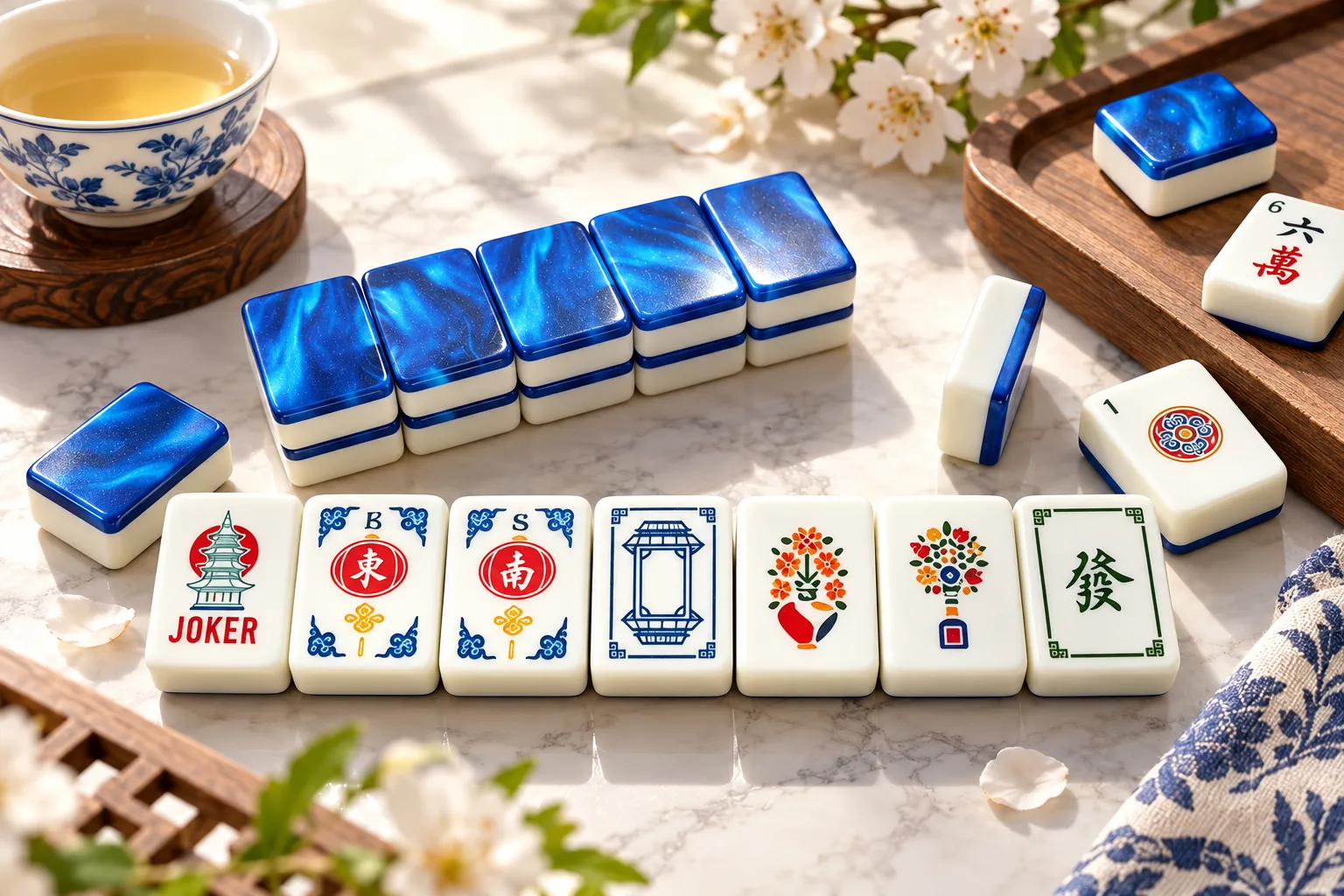
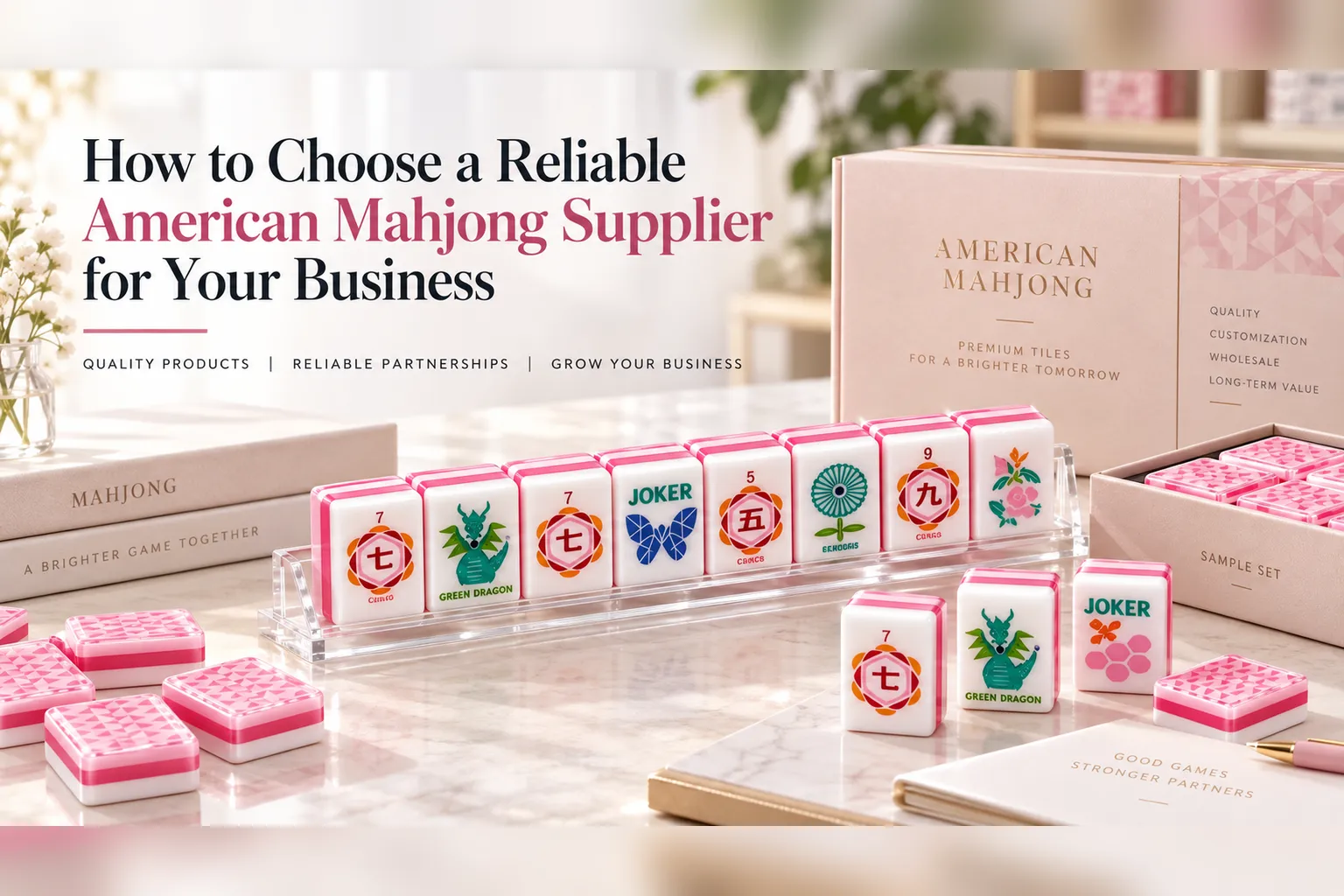
For retailers, distributors and private-label brands, choosing the right mahjong tile product is an important part of building a reliable Mahjong range.
A Mahjong set may look simple from the outside, but buyers need to consider much more than colour and appearance. Material, size, printing method, tile back design, packaging, custom artwork and quality control can all affect the final product.
This guide explains what B2B buyers should check when sourcing mahjong tile products for wholesale or private-label projects.
What Is a Mahjong Tile?
A mahjong tile is one of the individual playing pieces used in Mahjong.
Depending on the game version, a complete set may include several tile categories such as:
- Dots
- Bamboo
- Characters
- Winds
- Dragons
- Flowers
- Seasons
- Jokers
- Blank tiles
Different Mahjong markets may use different tile configurations, so wholesale buyers should confirm the exact set structure before ordering.
Why Mahjong Tile Specifications Matter
For B2B buyers, small differences in mahjong tile specifications can affect:
- Customer experience
- Product quality
- Packaging size
- Shipping cost
- Retail positioning
- Compatibility with racks
- Production cost
This is why it is important to define the product clearly before requesting a quotation.
1. Choose the Right Mahjong Tile Material
The material used for a mahjong tile affects weight, feel, durability and appearance.
Common materials may include:
Melamine
Melamine is widely used because it can provide:
- Good durability
- Smooth surface
- Stable colour
- Consistent shape
It is suitable for both standard and custom Mahjong products.
Acrylic
Acrylic can be used for more decorative or modern tile designs.
It may offer:
- Bright colours
- Transparent or translucent effects
- Layered designs
- Premium visual appearance
Resin
Resin can allow more creative shapes and colour effects, depending on the production process.
The right material depends on the target market and price positioning.
2. Confirm Mahjong Tile Dimensions
Before ordering a mahjong tile product in bulk, always confirm the exact dimensions.
Buyers should specify:
- Height
- Width
- Thickness
Do not rely only on photos.
Even small differences in tile dimensions can affect:
- Rack fit
- Storage tray fit
- Overall set weight
- Packaging dimensions
- Shipping cost
For private-label projects, dimensions should be written clearly in the product specification sheet.
3. Keep Tile Size Consistent Across the Set
Every mahjong tile in the same set should have consistent physical dimensions.
Check that:
- Number tiles match
- Wind tiles match
- Dragon tiles match
- Flower tiles match
- Jokers match
Uneven tile sizes can make the product feel lower quality and may also affect gameplay.
4. Check Tile Weight
Weight is another important part of the playing experience.
A mahjong tile that is too light may feel less substantial.
A very heavy tile may increase:
- Shipping cost
- Carton weight
- Retail packaging requirements
Wholesale buyers should test the weight of a physical sample before approving mass production.
5. Choose the Right Surface Finish
A mahjong tile can have different surface finishes.
Common options may include:
- Glossy
- Matte
- Semi-gloss
Glossy finishes may look bright and polished, while matte finishes may reduce reflections.
The best finish depends on the product style and customer preference.
6. Check Printing or Engraving Quality
The tile face is one of the most important areas to inspect.
A mahjong tile may use:
- Printed artwork
- Engraved artwork
- Filled engraving
- Layered printing
Buyers should check:
- Line sharpness
- Colour accuracy
- Registration
- Symbol clarity
- Consistency between tiles
Poor printing can make even a well-made tile look low quality.
7. Make Sure Numbers and Symbols Are Correct
Mahjong products require accuracy.
Every mahjong tile should be checked for:
- Correct number
- Correct symbol
- Correct suit
- Correct direction
- Correct colour
- Correct quantity
For example, buyers should carefully review Winds, Dragons, Flowers and Jokers.
One incorrect tile can affect the usability of the entire set.
8. Consider the Target Mahjong Version
Not every mahjong tile configuration is suitable for every market.
For example:
American Mahjong
American Mahjong sets may include:
- Jokers
- Tile racks
- Larger tile quantities
- English or number markings
Chinese Mahjong
Chinese Mahjong sets may follow a more traditional tile structure.
Japanese Riichi Mahjong
Riichi Mahjong has its own tile configuration and playing requirements.
Wholesale buyers should decide the target game version before confirming production.
9. Decide Whether English Labels Are Needed
For some markets, especially beginner-oriented retail products, English labels can make a mahjong tile easier to understand.
This may include markings for:
- East
- South
- West
- North
or readable numbers on Character tiles.
However, more traditional customers may prefer classic artwork without additional labels.
10. Check Colour Contrast
Good colour contrast improves readability.
A mahjong tile should have artwork that is easy to see against the tile face.
Buyers should check:
- Red visibility
- Green visibility
- Blue visibility
- Black line clarity
- Background contrast
This is especially important for decorative custom designs.
11. Custom Mahjong Tile Faces
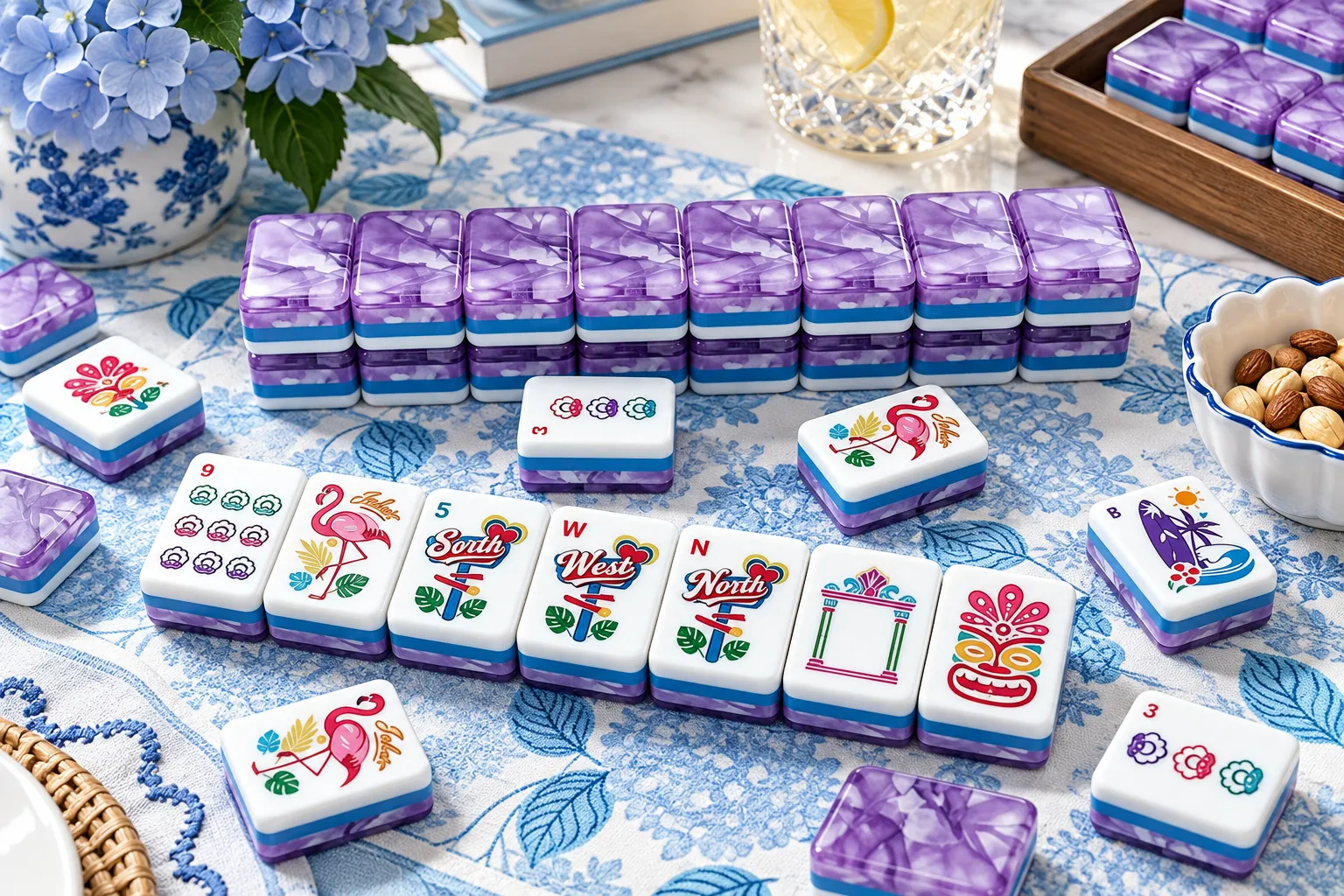
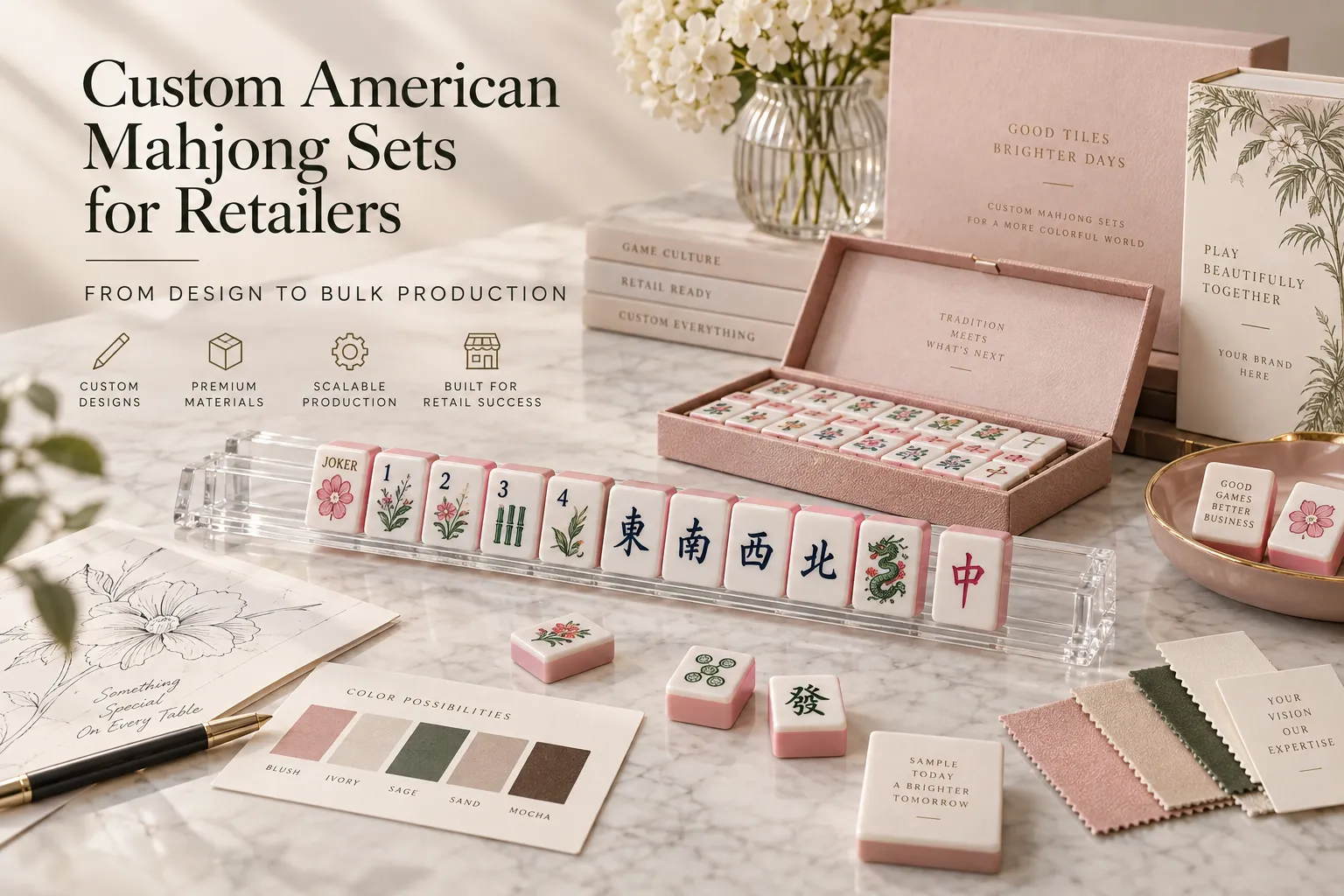
Private-label brands may want a custom mahjong tile design instead of a standard layout.
Possible customisations include:
- Custom Characters
- Custom Flowers
- Custom Jokers
- Brand symbols
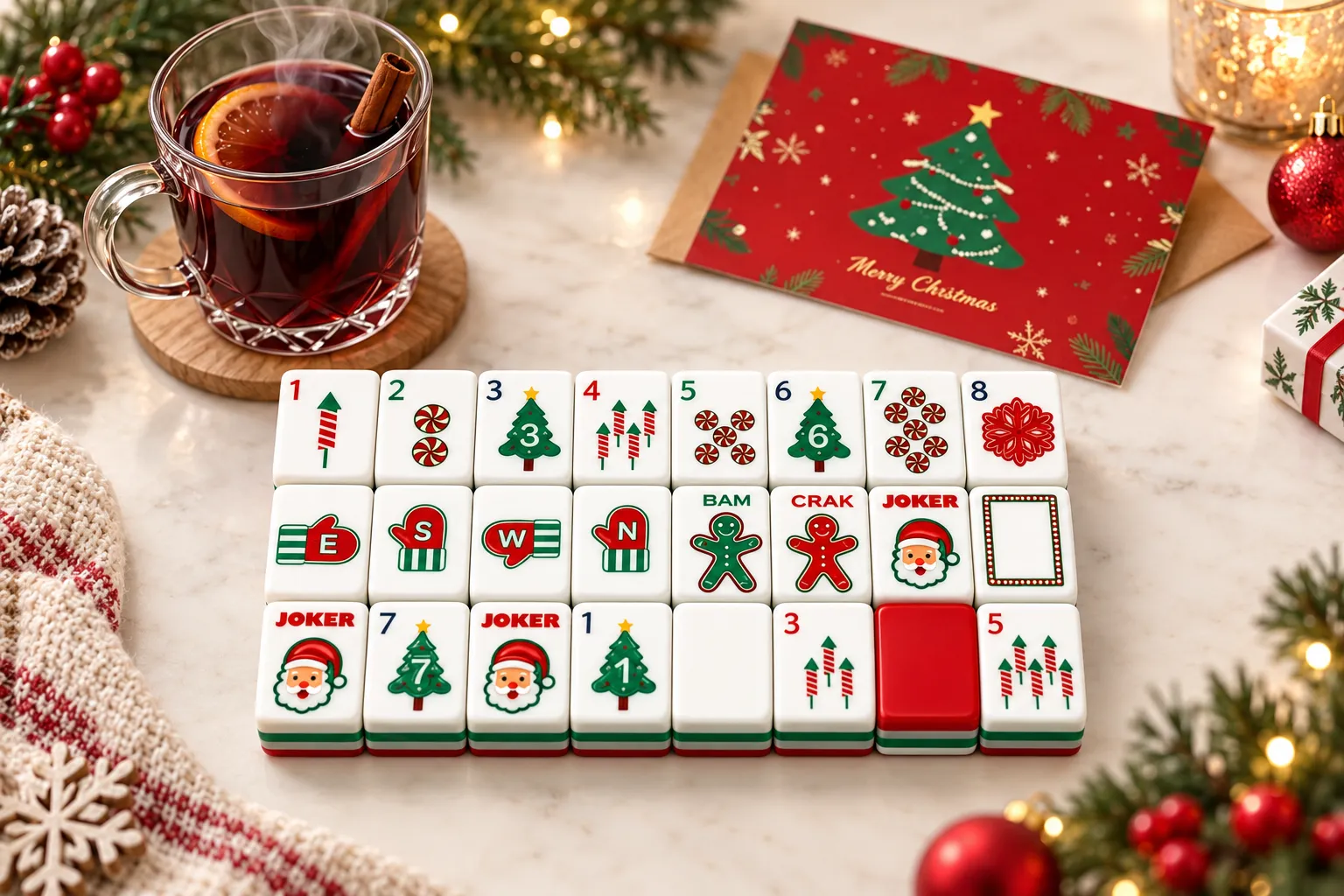
- Illustrated themes
- Seasonal artwork
- Lifestyle designs
Custom artwork should be prepared carefully because each tile face may require separate production files.
12. Custom Mahjong Tile Backs
The back of the mahjong tile can also be customised.
Possible options may include:
- Solid colours
- Marbled effects
- Transparent layers
- Printed patterns
- Logos
- Brand colours
The tile back is often one of the strongest visual branding opportunities in a private-label set.
13. Prepare Artwork Correctly
For custom production, artwork quality is very important.
Reference images such as JPG, PNG or screenshots may help explain the design, but final production artwork may need to be supplied as Adobe Illustrator .AI files.
A final mahjong tile artwork file should clearly show:
- Tile face design
- Tile category
- Quantity
- Colours
- Size
- Front artwork
- Back artwork
Fonts should be outlined and artwork should be vector-based whenever possible.
14. Use Clear File Naming
For large custom projects, clear file naming helps reduce mistakes.
For example:
Dots_1-9.ai
Bamboo_1-9.ai
Characters_1-9.ai
Winds.ai
Dragons.ai
Flowers.ai
Jokers.ai
This makes each mahjong tile category easier to review before production.
15. Confirm the Complete Tile Configuration
Before placing an order, buyers should confirm the exact number of every mahjong tile in the set.
The specification should include:
- Number of Dots
- Number of Bamboo
- Number of Characters
- Number of Winds
- Number of Dragons
- Number of Flowers
- Number of Jokers
- Number of spare tiles
Do not rely on a general set description.
16. Consider Tile Rack Compatibility
If racks are included, test whether the mahjong tile fits properly.
Check:
- Tile thickness
- Rack slot width
- Stability
- Viewing angle
- Number of tiles per rack
This is especially important for American Mahjong products.
17. Request a Physical Sample
Before approving mass production, wholesale buyers should review a physical mahjong tile sample.
Check:
- Tile dimensions
- Weight
- Surface finish
- Artwork
- Colour
- Back design
- Edge quality
- Rack compatibility
A physical sample can reveal issues that are difficult to see in digital artwork.
18. Compare the Sample With the Approved Artwork
After receiving the sample, compare every visible detail against the final production file.
Check:
- Position
- Scale
- Colour
- Symbol accuracy
- Orientation
- Tile numbering
For custom mahjong tile projects, this step is critical.
19. Check Packaging Fit
The finished tile dimensions affect packaging design.
Buyers should confirm whether the mahjong tile set fits correctly in:
- Trays
- Boxes
- Carry cases
- Drawstring bags
- Retail cartons
Packaging should hold the tiles securely without excessive movement.
20. Consider Shipping Weight
A full Mahjong set can become relatively heavy.
The weight of each mahjong tile affects:
- Set weight
- Master carton weight
- Freight cost
- Warehouse handling
Wholesale buyers should ask for:
- Net weight
- Gross weight
- Units per carton
- Carton dimensions
before calculating landed cost.
21. Understand MOQ
MOQ may depend on the type of mahjong tile project.
A standard product may have one MOQ, while custom projects may require a different quantity.
MOQ can also vary by:
- Tile material
- Tile colour
- Custom artwork
- Tile back
- Packaging
- Printing method
Always confirm whether MOQ applies per design or per total order.
22. Understand Customisation Costs
Customisation is normally a paid service.
Costs may depend on:
- Artwork complexity
- Colour matching
- Printing setup
- Engraving setup
- Sample development
- Custom tile backs
- Packaging
- Tooling
Wholesale buyers should provide a clear specification before requesting an accurate quote.
23. Quality Control Before Shipping
Before shipment, a wholesale mahjong tile order should be checked for consistency.
Key inspection points include:
- Tile quantity
- Tile size
- Artwork accuracy
- Colour consistency
- Surface defects
- Packaging condition
- Accessory quantity
Random carton inspections can help identify problems before the goods leave the factory.
24. Build Different Mahjong Tile Product Levels
Retailers can create different product levels around the same category.
Entry-Level
Simple standard artwork and practical packaging.
Mid-Range
Better materials, more decorative tile backs and upgraded storage.
Premium
Custom artwork, premium packaging and coordinated accessories.
This gives buyers more flexibility when planning a mahjong tile product range.
25. Combine Mahjong Tiles With Accessories
A Mahjong product does not need to be sold alone.
Retailers can bundle mahjong tile sets with:
- Tile racks
- Mahjong mats
- Dice
- Carry cases
- Reference cards
- Storage trays
This can help create higher-value retail packages.
Working With HUHU Mahjong
HUHU Mahjong supports retailers, distributors, clubs and private-label brands sourcing Mahjong products for international markets.
B2B buyers can discuss:
- Mahjong tile size
- Material
- Artwork
- Tile backs
- Packaging
- Accessories
- MOQ
- Sample requirements
- Wholesale quantity
For custom projects, final production artwork may need to be provided in Adobe Illustrator .AI format.
Final Thoughts
Choosing the right mahjong tile product requires more than selecting a design.
Wholesale buyers should pay attention to:
- Material
- Dimensions
- Weight
- Printing quality
- Tile accuracy
- Customisation
- Packaging
- MOQ
- Sample approval
- Quality control
A well-specified mahjong tile product is easier to manufacture, easier to inspect and more suitable for retail sale.
For B2B buyers, the best approach is to define the product clearly, approve a physical sample and confirm every tile detail before mass production.
About the Author
HUHU Team
We share industry insights, product knowledge, and manufacturing updates to help global clients better understand mahjong production and OEM solutions.