
OEM/ODM MANUFACTURING FOR GLOBAL BRANDS
- View Our Alibaba Store
- info@huhumahjong.com
- +86 13326907761
How to Compare Mahjong Suppliers Beyond Price
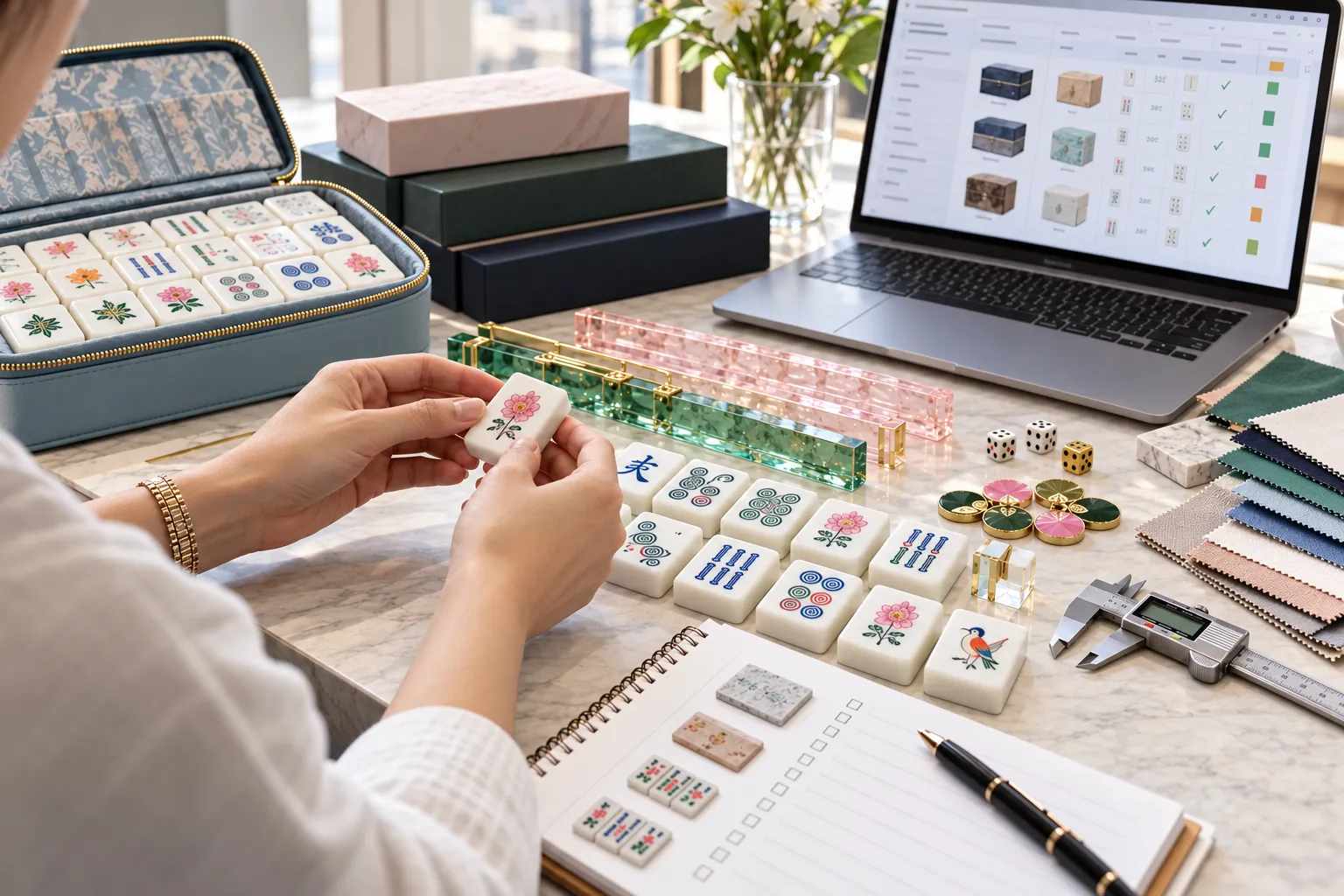
When sourcing Mahjong products for retail, wholesale or private label, many buyers begin by comparing unit prices.
Price matters, but it should never be the only factor when you compare Mahjong suppliers.
Two factories may quote very different prices for products that look almost identical in a photo. However, the actual differences may include material quality, tile dimensions, printing, packaging, production consistency, quality control and shipping preparation.
For retailers and brands, choosing the wrong supplier can lead to delayed launches, inconsistent products, damaged packaging or expensive rework.
This guide explains how to compare Mahjong suppliers based on the complete purchasing process rather than price alone.
Why You Should Compare Mahjong Suppliers Beyond Unit Price
The lowest quotation does not always create the lowest final cost.
A cheaper Mahjong set may come with:
- Lower-quality materials
- Less accurate colour control
- Basic packaging
- Longer production times
- Limited quality inspection
- Higher defect rates
- Poor carton efficiency
- Weak repeat-order consistency
A slightly higher factory price may ultimately provide better value if the supplier delivers a more reliable retail-ready product.
When you compare Mahjong suppliers, the goal should be to understand what is actually included in each quotation.
1. Compare MOQ Requirements
Start with MOQ.
Ask each supplier about:
- MOQ for existing designs
- MOQ for custom designs
- MOQ for custom colours
- MOQ for custom packaging
- MOQ for accessories
- Sample quantities
MOQ affects inventory risk and cash flow.
For a new brand testing its first collection, a supplier with a more flexible MOQ may be more suitable even if the unit price is slightly higher.
2. Compare Sample Quality
Samples are one of the most useful tools when you compare Mahjong suppliers.
Do not evaluate suppliers only through catalog photos.
Inspect the physical sample for:
- Tile finish
- Printing clarity
- Engraving depth
- Edge quality
- Surface polishing
- Colour consistency
- Weight
- Packaging quality
The sample should represent the quality standard expected during bulk production.
For custom projects, it is also useful to keep an approved master sample for future comparison.
3. Compare Materials Carefully
Make sure every supplier is quoting the same material.
Mahjong tiles may be produced from materials such as:
- Acrylic
- Melamine
- Resin
- Layered acrylic
- Other composite materials
Material affects:
- Weight
- Appearance
- Durability
- Transparency
- Surface feel
- Production cost
If Supplier A is quoting acrylic and Supplier B is quoting a different material, the two prices are not directly comparable.
Before you compare Mahjong suppliers, ask for the exact material specification.
4. Compare Tile Size and Weight
Tile dimensions can also affect the quotation.
Confirm:
- Height
- Width
- Thickness
- Individual tile weight
- Complete set weight
Larger or thicker tiles normally require more material and can increase shipping weight.
Tile dimensions can also affect rack compatibility and retail packaging size.
Using the same specification when requesting quotations makes supplier comparisons much more accurate.
5. Compare Customization Capability
Not every Mahjong manufacturer offers the same customization depth.
Possible options include:
- Custom tile faces
- Custom tile backs
- Custom Jokers
- Custom Flowers
- Custom colours
- UV printing
- Engraving
- Colour filling
- Layered acrylic
- Custom racks and pushers
- Custom packaging
- Logo printing
If you are developing a private-label product, you should compare Mahjong suppliers based on whether they can support the entire product rather than only the tiles.
This reduces the need to coordinate multiple factories.
6. Compare Artwork Support
Good artwork preparation can prevent many production problems.
Ask whether the supplier checks:
- File resolution
- Tile layout
- Artwork positioning
- Engraving line thickness
- Colour references
- Bleed areas
- Packaging artwork
Experienced suppliers should identify obvious file problems before production begins.
Clear artwork approval also helps ensure the final production file does not change unexpectedly.
7. Compare Colour Control
Colour can be difficult to evaluate through a computer screen.
For custom products, ask how each supplier controls:
- Tile colours
- Printed artwork
- Acrylic layers
- Packaging colours
- Brand logos
Pantone references can provide a shared colour language between designers, buyers and production teams. Pantone specifically positions its matching system as a tool for colour communication across print, packaging and production. Pantone Formula Guide and colour standards
However, buyers should still remember that the same colour can look different on different materials.
Physical samples or material swatches are useful before mass production.
This is especially important when you compare Mahjong suppliers for branded products.
8. Compare Printing and Engraving Methods
Ask how each supplier creates the tile artwork.
Methods may include:
- UV printing
- Screen printing
- Laser engraving
- Deep engraving
- Colour-filled engraving
Different processes can produce different:
- Surface textures
- Durability
- Colour effects
- Detail levels
- Costs
Make sure you are comparing the same production method.
A printed tile and a deeply engraved tile should not be evaluated only by unit price.
9. Compare Production Lead Times
Ask for realistic lead times for:
- Artwork preparation
- Sampling
- Sample revision
- Bulk production
- Packaging
- Final inspection
- Shipping preparation
For seasonal products, timing can be as important as price.
A low quotation is not very useful if the product arrives after the planned retail launch.
When you compare Mahjong suppliers, ask whether lead times change during busy production periods.
10. Compare Production Capacity
Capacity becomes important as your business grows.
Ask:
- What is the normal monthly capacity?
- Can production scale for larger orders?
- Can the supplier handle repeat orders?
- Can multiple designs be produced together?
A supplier suitable for 100 sets may not automatically be suitable for 5,000 sets.
If you expect repeat business, choose a supplier that can support future growth.
11. Compare Quality Control
Quality control should be one of the most important factors when you compare Mahjong suppliers.
Ask whether the supplier uses:
- Incoming material inspection
- First-piece inspection
- In-process inspection
- Random sampling
- Final product inspection
- Packing inspection
For custom projects, QC should compare production against the approved sample and specification.
A small difference in price may be worthwhile if it reduces defects and customer complaints.
12. Compare Bulk Production Consistency
A good sample alone is not enough.
Ask how the manufacturer makes sure bulk production stays consistent with the approved sample.
Important points include:
- Tile dimensions
- Colour
- Artwork position
- Engraving depth
- Surface finish
- Packaging
- Accessories
Also consider repeat orders.
If you reorder six months later, the second production batch should remain as close as possible to the original product.
13. Compare Packaging Capability
Retail packaging should be included when you compare Mahjong suppliers.
Ask about options such as:
- Standard boxes
- Custom gift boxes
- Magnetic boxes
- Carrying cases
- Printed sleeves
- Inserts
- Logo printing
- Barcode labels
Packaging affects both retail presentation and shipping volume.
An oversized box may look impressive but increase freight costs significantly.
14. Compare Retail-Ready Labeling
If the Mahjong set will go directly into retail or e-commerce fulfilment, ask whether the supplier can apply:
- SKUs
- UPC or EAN barcodes
- Carton labels
- Product labels
- Country-of-origin markings
- Product inserts
For standardized retail identification, GS1 provides globally used GTIN and barcode standards. GS1 notes that UPC and EAN formats are widely used for retail product identification. GS1 barcode standards
GS1 also explains that the brand owner is normally responsible for allocating the product’s GTIN, rather than the factory simply inventing a barcode.
This is useful to confirm before packaging enters mass production.
15. Compare Communication Quality
Communication is easy to overlook, but it affects every stage of the project.
Evaluate:
- Response speed
- Clarity
- Understanding of your specifications
- Ability to explain technical issues
- Accuracy of quotations
- Follow-up during production
When you compare Mahjong suppliers, consider how easily you can resolve questions with each supplier.
Poor communication can turn small misunderstandings into expensive production mistakes.
16. Compare Documentation
Professional suppliers should provide clear records.
These may include:
- Formal quotations
- Product specifications
- Artwork approvals
- Sample approval records
- Commercial invoices
- Packing lists
- Carton information
Written documentation is particularly important for custom orders.
Do not rely entirely on scattered chat messages for important production specifications.
17. Compare Shipping Preparation
Ask each supplier for:
- Units per carton
- Master carton dimensions
- Gross weight
- Net weight
- Total number of cartons
- CBM
- Pallet options
Efficient carton packing can reduce international freight costs.
Two suppliers offering the same unit price may create very different shipping costs if one uses significantly larger packaging.
18. Compare Total Landed Cost
This is one of the most important calculations when you compare Mahjong suppliers.
The real cost may include:
- Product cost
- Custom packaging
- Labels
- Freight
- Customs duties
- Import taxes
- Local delivery
- Warehouse handling
Do not automatically choose the supplier with the lowest EXW or FOB product price.
Calculate what the product will cost when it actually reaches your warehouse.
19. Compare Payment Terms
Ask suppliers to confirm:
- Deposit requirement
- Balance payment timing
- Sample payment
- Accepted payment methods
- When production starts
The terms should be clear before you place an order.
Be cautious if payment requirements change unexpectedly during the project.
20. Check American Mahjong Experience
American Mahjong has product requirements that differ from many traditional Mahjong sets.
An experienced supplier should understand:
- Jokers
- Flowers
- American-style tile dimensions
- Racks
- Pushers
- Decorative tile backs
- Modern artwork styles
When you compare Mahjong suppliers, experience with American Mahjong can make product development much easier.
21. Check Private Label Experience
Private-label projects require more than manufacturing tiles.
The supplier may need to coordinate:
- Branding
- Packaging
- Barcodes
- Inserts
- Carton labels
- Artwork revisions
- Repeat production
Ask to see examples of the supplier’s customization capabilities and production process.
22. Compare Repeat-Order Support
A supplier relationship becomes more valuable when repeat orders are easy.
Ask whether they retain:
- Artwork files
- Colour references
- Material specifications
- Packaging specifications
- Approved sample records
This can reduce development time for future orders and improve consistency.
23. Look for Supplier Red Flags
When you compare Mahjong suppliers, be cautious if a supplier:
- Avoids providing detailed specifications
- Refuses sample requests
- Cannot explain materials
- Cannot describe its QC process
- Changes quotations repeatedly
- Gives unrealistic lead times
- Uses unclear payment terms
- Provides inconsistent answers
A very low quotation should not outweigh major warning signs.
Compare Mahjong Suppliers With One Checklist
Use the same checklist for every factory:
- Unit price
- MOQ
- Sample quality
- Material
- Tile dimensions
- Tile weight
- Customization
- Printing or engraving
- Colour control
- Lead time
- Capacity
- QC
- Packaging
- Retail labeling
- Communication
- Shipping preparation
- Payment terms
- Repeat-order support
Using the same criteria makes it much easier to compare Mahjong suppliers fairly.
A Simple Supplier Comparison Example
Imagine two factories quote the same custom Mahjong project.
Supplier A
- Lower unit price
- Higher MOQ
- Basic packaging
- Limited artwork assistance
- Minimal QC information
- Longer production lead time
Supplier B
- Slightly higher unit price
- More flexible MOQ
- Custom packaging support
- Detailed sample approval
- Clear QC procedures
- Better repeat-order records
Supplier A looks cheaper if you compare only unit price.
Supplier B may provide better overall value if it reduces inventory risk, packaging work and quality problems.
This is exactly why buyers should compare Mahjong suppliers across the entire project.
Final Thoughts
The best Mahjong supplier is not automatically the factory offering the lowest quotation.
When you compare Mahjong suppliers, look at the complete process:
Sample → Materials → Customization → Production → QC → Packaging → Shipping → Repeat Orders
A reliable manufacturing partner should provide clear specifications, realistic lead times, consistent quality and professional communication.
For retailers, distributors and private-label brands, a better supplier decision can reduce risk and make future product launches much easier.
Looking for a Mahjong Manufacturing Partner?
HUHU Mahjong supports retailers, distributors and brands with wholesale American Mahjong sets, OEM production, custom designs, private-label packaging and bulk manufacturing.
If you are ready to compare Mahjong suppliers, send us your target product, quantity, artwork, packaging requirements and destination.
About the Author
HUHU Team
We share industry insights, product knowledge, and manufacturing updates to help global clients better understand mahjong production and OEM solutions.