OEM/ODM MANUFACTURING FOR GLOBAL BRANDS
- View Our Alibaba Store
- info@huhumahjong.com
- +86 13326907761
Mahjong Tile Manufacturing Process: From Raw Materials to Finished Products
Have you ever wondered how a Mahjong tile is made? Behind every finished Mahjong set is a manufacturing process involving material selection, precision forming, printing, surface finishing and quality inspection.
Understanding the Mahjong Tile Manufacturing Process is important for retailers, wholesalers and private-label brands looking for a reliable manufacturing partner. The production process can influence the appearance, dimensions, surface quality and consistency of the finished tiles.
For businesses sourcing Mahjong products in bulk, knowing how each manufacturing stage works can also make it easier to evaluate suppliers, review samples and communicate product requirements.
In this guide, we take a closer look at the Mahjong Tile Manufacturing Process, from the initial selection of materials to final inspection and international delivery.
1. Material Selection: The Foundation of Mahjong Tile Manufacturing
The first stage of the Mahjong Tile Manufacturing Process is selecting suitable raw materials.
Different materials offer different visual and physical characteristics. The choice depends on the intended product style, target market, production requirements and budget.
Common materials used in Mahjong products include:
Acrylic
Acrylic is widely used for modern Mahjong collections because it offers a smooth finish and flexibility in colour and design.
It can be developed in different colour combinations and decorative styles, making it suitable for premium retail products and customised collections.
Melamine
Melamine is another material used in Mahjong tile production. It is commonly associated with traditional-style tile designs and practical everyday collections.
Its suitability depends on the required tile specifications and manufacturing process.
Other Material Options
Some products may incorporate additional materials or layered constructions to achieve a particular appearance or feel.
When selecting materials, manufacturers need to consider:
- Required tile dimensions.
- Material appearance and colour.
- Surface characteristics.
- Weight and handling.
- Production compatibility.
- Target retail positioning.
At HUHU Mahjong, material selection is an important part of the initial product consultation. Buyers can discuss their preferred materials and product requirements before sample development begins.
2. Molding and Forming: Creating Consistent Tile Shapes
After material selection, the next stage involves forming the tile structure.
This is an important part of the Mahjong Tile Manufacturing Process because the dimensions and shape of each tile influence the appearance and handling of the finished set.
Depending on the selected material and product design, manufacturing may involve precision molding or other forming techniques.
The main objectives are to achieve:
- Consistent tile dimensions.
- Uniform thickness.
- Accurate structural shape.
- Smooth edges.
- Consistent proportions across the set.
For customised products, the manufacturer must also consider how the selected tile dimensions work with the planned artwork and accessories.
A small dimensional difference between tiles can become noticeable when an entire set is arranged together.
For this reason, the forming stage needs to follow the confirmed product specifications.
3. Printing and Engraving: Bringing Mahjong Artwork to Life
Once the tile structure has been prepared, the next stage focuses on the visual design.
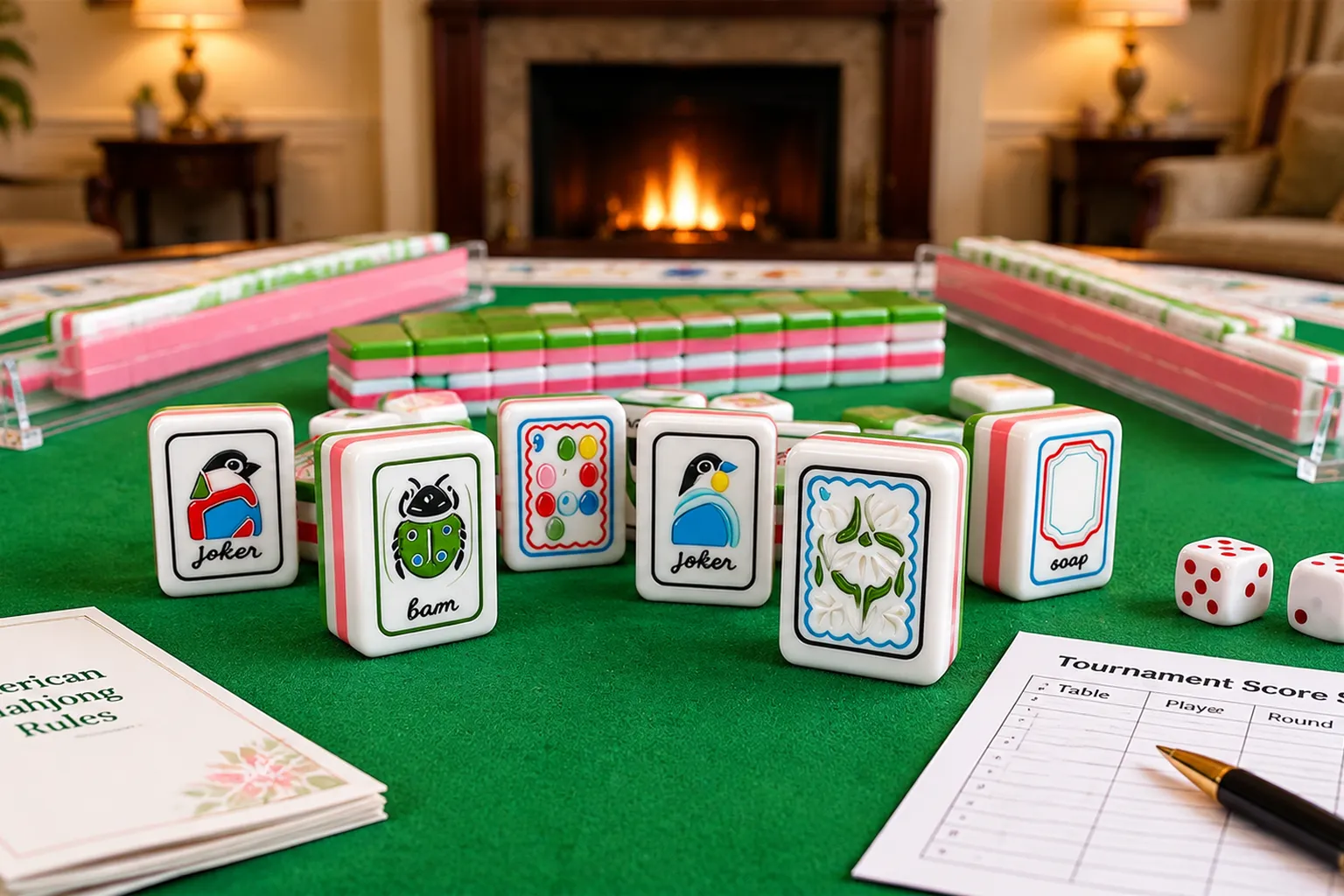
Printing and engraving are important parts of the Mahjong Tile Manufacturing Process, particularly for American Mahjong sets featuring detailed illustrations, numbers, colours and decorative symbols.
Depending on the design and production requirements, different marking methods may be used.
Printed Tile Artwork
Printing allows manufacturers to reproduce colours, illustrations and detailed graphics on Mahjong tiles.
This is particularly useful for custom collections featuring:
- Floral illustrations.
- Animal designs.
- Decorative patterns.
- Special Joker artwork.
- Brand-inspired graphics.
- Unique colour combinations.
Engraved Tile Designs
Engraving can be used to create defined markings and decorative details.
The appropriate method depends on the material, artwork and desired finish.
Artwork Accuracy
Before production, the manufacturer should work from approved artwork files.
Important details include:
- Correct numbers and symbols.
- Accurate artwork positioning.
- Consistent colours.
- Clear lines and illustrations.
- Correct tile orientation.
- Matching designs across repeated tiles.
For custom projects, artwork should be reviewed carefully before production begins.
You can also read our guide on How to Prepare AI Files to Customise Mahjong Tiles for more information about preparing production-ready design files.
4. Surface Finishing and Polishing
After forming and applying the tile artwork, surface finishing helps achieve the intended appearance and feel.
This stage is another important part of the Mahjong Tile Manufacturing Process.
Depending on the product specification, finishing may involve polishing, edge refinement and surface treatment.
Manufacturers need to pay attention to:
Surface smoothness
The tile surface should match the approved finish and should not have unwanted rough areas.
Edge consistency
Edges should be properly finished to provide a clean and comfortable handling experience.
Visual appearance
The finished surface should complement the selected material and artwork.
Consistency
Tiles within the same set should maintain a consistent appearance.
For premium collections, these finishing details can influence how customers perceive the overall product.
5. Quality Inspection During Mahjong Tile Production
Quality inspection should not be left until the final packaging stage.
A structured Mahjong Tile Manufacturing Process includes quality checks at relevant production stages.
Depending on the product specification, manufacturers may review:
Dimensional Accuracy
Selected tiles can be measured to confirm that their dimensions match the approved specifications.
Artwork and Printing
The printed designs should be compared with the approved artwork.
Inspectors may look for missing details, incorrect symbols, printing defects or noticeable positioning differences.
Colour Consistency
Colours should be compared against approved references or samples.
For customised collections, this is especially important because buyers may require specific colour combinations.
Surface Appearance
Tiles should be checked for visible defects such as scratches, chips, stains or other unacceptable surface issues.
Product Consistency
Tiles belonging to the same collection should maintain consistent dimensions, appearance and finishing.
At HUHU Mahjong, quality control is integrated into the manufacturing workflow, with final inspection before products are prepared for shipment.
For a more detailed explanation of wholesale inspection methods, read our article on Mahjong AQL Inspection.
6. Matching Mahjong Tiles With Accessories
A complete Mahjong set often includes more than the tiles themselves.
Depending on the product configuration, accessories may include:
- Mahjong racks.
- Pushers.
- Dice.
- Game chips.
- Betting indicators.
- Mahjong mats.
- Storage cases.
- Instruction booklets.
These components should be considered during product development rather than treated as unrelated additions.
For example, the dimensions of the tiles should be compatible with the selected racks.
The colours and appearance of accessories should also complement the overall product design.
Retailers developing a complete collection may prefer coordinated accessories to create a more consistent retail presentation.
Explore our Mahjong Products to see different sets and accessory options.
7. Sample Development Before Mass Production
Sampling is one of the most important stages for brands developing customised Mahjong products.
Even when the digital design looks correct, the physical product may reveal details that need adjustment.
A sample allows buyers to evaluate:
- Actual tile dimensions.
- Material appearance.
- Tile weight and feel.
- Printing clarity.
- Colour accuracy.
- Surface finishing.
- Artwork positioning.
- Accessory compatibility.
The sample should be compared with the approved design and product specifications.
If adjustments are needed, the buyer and manufacturer can discuss revisions before moving forward.
HUHU Mahjong provides sample development and revision support for eligible custom projects.
You can learn more about the different stages on our OEM Production Process page.
8. Mass Production and Manufacturing Consistency
Once the sample and specifications have been approved, the project can move into mass production.
This stage requires coordination between material preparation, forming, artwork application, finishing and inspection.
For larger orders, maintaining consistency becomes particularly important.
A reliable Mahjong Tile Manufacturing Process should follow clearly confirmed product specifications throughout production.
Important considerations include:
- Using the approved material.
- Following the confirmed dimensions.
- Maintaining artwork consistency.
- Applying the agreed finishing requirements.
- Monitoring production quality.
- Keeping records of approved specifications.
For private-label brands, consistency is especially important because customers expect repeat orders to match the original collection.
Manufacturers should also communicate any production issues that may affect the approved specifications or delivery schedule.
9. Final Inspection and Packaging
Before products are shipped, the finished Mahjong sets need to be checked against the order requirements.
The final inspection may cover:
- Tile quantity.
- Tile appearance.
- Accessories.
- Product dimensions.
- Packaging condition.
- Branding and labels.
- Order completeness.
Packaging is selected according to the product positioning and shipping requirements.
Common options may include retail boxes, storage cases, protective inserts and customised gift packaging.
For international orders, outer packaging also needs to be suitable for the agreed transportation method.
At HUHU Mahjong, packaging and delivery form the final stage of the production workflow.
10. What Should Buyers Ask a Mahjong Manufacturer?
Understanding the Mahjong Tile Manufacturing Process can help buyers ask more useful questions before placing an order.
If you are sourcing Mahjong products for your business, consider discussing the following:
Material and Specifications
Ask which materials are available and confirm the dimensions, thickness and finish of the selected tiles.
Customisation Options
Find out whether the manufacturer can support custom colours, artwork, logos, tile backs and accessories.
Sample Arrangements
Confirm the sample cost, development time and whether revisions are available.
Quality Control
Ask how the manufacturer checks dimensions, printing, surface appearance and finished product consistency.
Production Schedule
Confirm the estimated sampling and mass production timelines before planning your product launch.
Order Requirements
Discuss MOQ, order quantities, packaging and shipping arrangements.
Providing clear requirements at the beginning can make communication easier and help avoid unnecessary changes later.
11. How HUHU Mahjong Supports the Manufacturing Process
HUHU Mahjong provides OEM and ODM manufacturing solutions for international retailers, distributors, clubs and private-label brands.
Our manufacturing workflow covers several stages:
- Product consultation.
- Design confirmation.
- Material selection.
- Sample development.
- Mass production and quality control.
- Packaging and delivery.
With more than 12 years of Mahjong manufacturing experience, our team supports businesses developing standard and customised Mahjong collections.
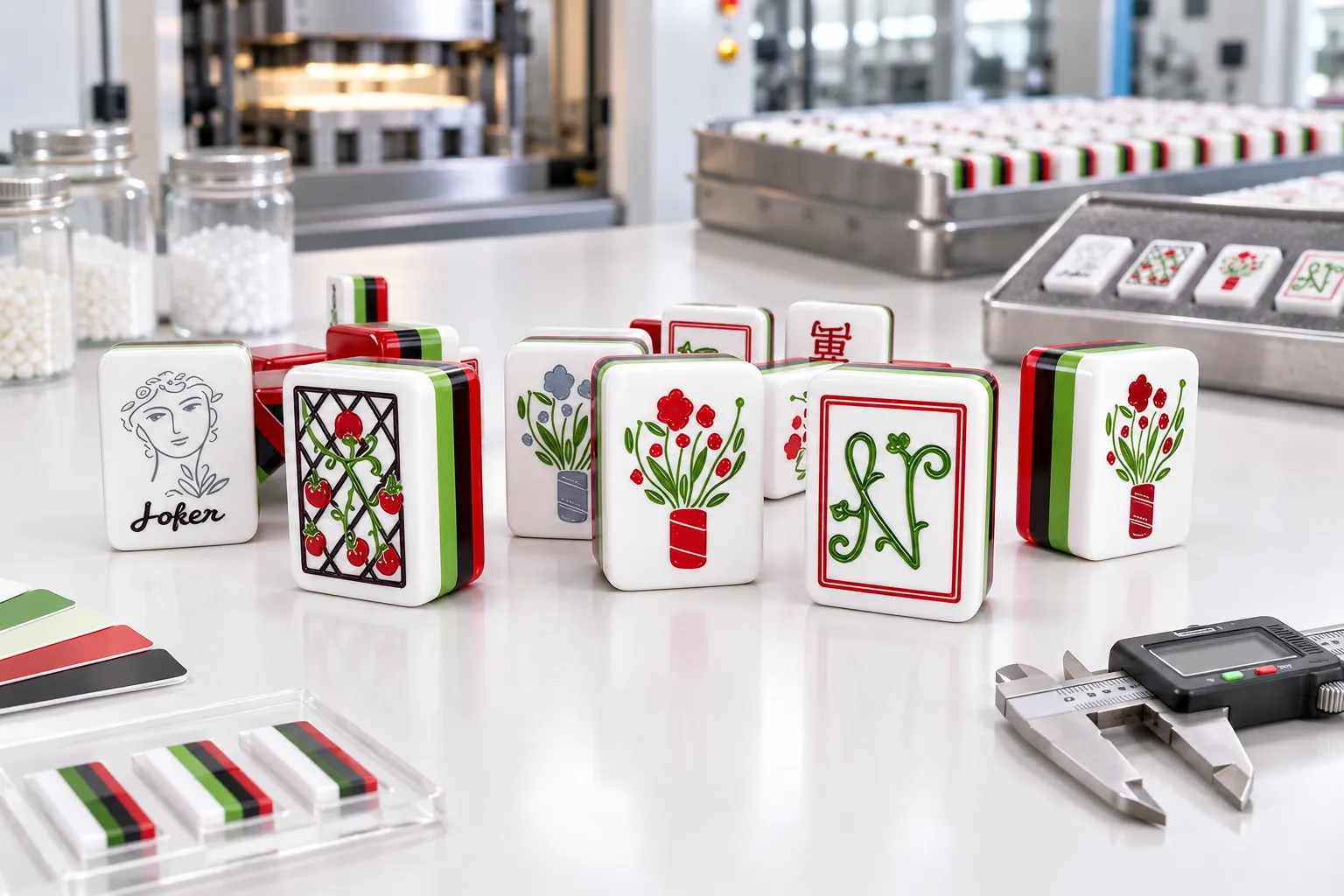
Our factory capabilities include material selection, molding and forming, printing and engraving, surface finishing, polishing and quality inspection.
You can explore our Factory Tour to learn more about our manufacturing environment and production capabilities.
For examples of customised products, visit our Mahjong Manufacturing Case Studies.
If you are planning a new product collection, our OEM and Custom Manufacturing Services provide more information about available options.
Frequently Asked Questions
How long does Mahjong tile manufacturing take?
The production timeline depends on material, design complexity, order quantity and customisation requirements.
For HUHU Mahjong, standard samples are generally prepared within 7–10 working days, while custom sample projects may require additional time.
Bulk production timelines should be confirmed according to the specific order.
What materials are commonly used for Mahjong tiles?
Acrylic and melamine are among the materials used for Mahjong tiles. The most suitable option depends on the required appearance, product positioning and manufacturing specifications.
Can Mahjong tiles be customised?
Yes. Depending on the project, buyers can discuss custom colours, artwork, tile backs, logos and other design elements.
Why is sample approval important?
A physical sample allows buyers to evaluate the actual material, dimensions, colours, artwork and finishing before approving mass production.
Does the manufacturing process include quality inspection?
Quality inspection is an important part of the production workflow. Checks may cover dimensions, artwork, colour consistency, surface appearance and final product completeness.
Can manufacturers produce matching Mahjong accessories?
Yes. Depending on the manufacturing requirements, Mahjong sets can be developed with matching racks, pushers, dice, chips, mats and storage solutions.
Conclusion
The Mahjong Tile Manufacturing Process involves multiple stages, from material selection and forming to artwork application, surface finishing, quality inspection and final packaging.
Each stage contributes to the appearance, consistency and overall usability of the finished product.
For retailers and private-label brands, understanding these manufacturing stages makes it easier to communicate specifications, review samples and select a suitable manufacturing partner.
A well-organised production workflow, combined with clear product requirements and careful inspection, helps businesses develop Mahjong collections that are ready for their target markets.
If you are looking for a Mahjong manufacturer for standard or customised products, contact HUHU Mahjong to discuss your project, material preferences, artwork and wholesale requirements.
About the Author
HUHU Team
We share industry insights, product knowledge and manufacturing updates to help global clients better understand Mahjong production and OEM solutions.
About the Author
HUHU Team
We share industry insights, product knowledge, and manufacturing updates to help global clients better understand mahjong production and OEM solutions.