
OEM/ODM MANUFACTURING FOR GLOBAL BRANDS
- View Our Alibaba Store
- info@huhumahjong.com
- +86 13326907761
Mahjong Supplier Audit: What Buyers Should Check Before Bulk Orders

A Mahjong supplier audit can help wholesale buyers reduce risk before placing a large production order.
For retailers, distributors and private-label brands, approving a good sample is important, but it does not always tell you everything about the supplier behind it. Production capacity, quality control, material sourcing, packaging capability, documentation and repeat-order consistency can all affect the success of a bulk order.
A structured Mahjong supplier audit gives buyers a clearer picture of whether a supplier can reliably handle production beyond the sample stage.
This guide explains what buyers should check before paying a deposit or moving into mass production.
Why a Mahjong Supplier Audit Matters
Bulk production involves more risk than ordering a few samples.
Problems may include:
- Inconsistent tile quality
- Colour variation
- Delayed production
- Weak packaging
- Incorrect artwork
- Poor quality control
- Limited production capacity
- Incomplete export documentation
A Mahjong supplier audit helps buyers identify these risks earlier.
The goal is not simply to find a factory with the lowest price. It is to understand whether the supplier has the systems, equipment and experience needed to deliver the order consistently.
1. Verify the Supplier’s Business Information
Start with the basic company information.
Ask for:
- Registered company name
- Business address
- Business licence
- Years in operation
- Main product categories
- Export experience
The company name used on quotations, invoices and payment instructions should be consistent.
If different company names appear across documents, ask for an explanation before paying.
A basic Mahjong supplier audit should confirm who you are actually doing business with.
2. Confirm Whether They Are a Factory or Trading Company
Both factories and trading companies can be suitable partners, but buyers should know which type of supplier they are working with.
A factory may directly control:
- Production
- Materials
- QC
- Lead times
A trading company may coordinate multiple factories and provide:
- Product sourcing
- Broader product ranges
- Communication support
- Export coordination
Neither model is automatically better.
The important point is transparency.
During a Mahjong supplier audit, ask which processes are completed in-house and which are outsourced.
3. Review Mahjong Production Experience
Ask how long the supplier has produced Mahjong products.
More specifically, check experience with:
- American Mahjong
- Custom tile artwork
- Jokers
- Flowers
- Racks
- Pushers
- Custom packaging
- Private-label projects
American Mahjong products can have different requirements from traditional Mahjong sets.
Experience with similar orders can reduce development mistakes.
4. Check the Sample Room
If possible, review previous samples or completed projects.
Look for different:
- Tile materials
- Tile sizes
- Colours
- Printing methods
- Engraving styles
- Packaging formats
A well-organized sample room can also help buyers understand the supplier’s range of capabilities.
For a remote Mahjong supplier audit, ask for a live video walkthrough rather than only edited product photos.
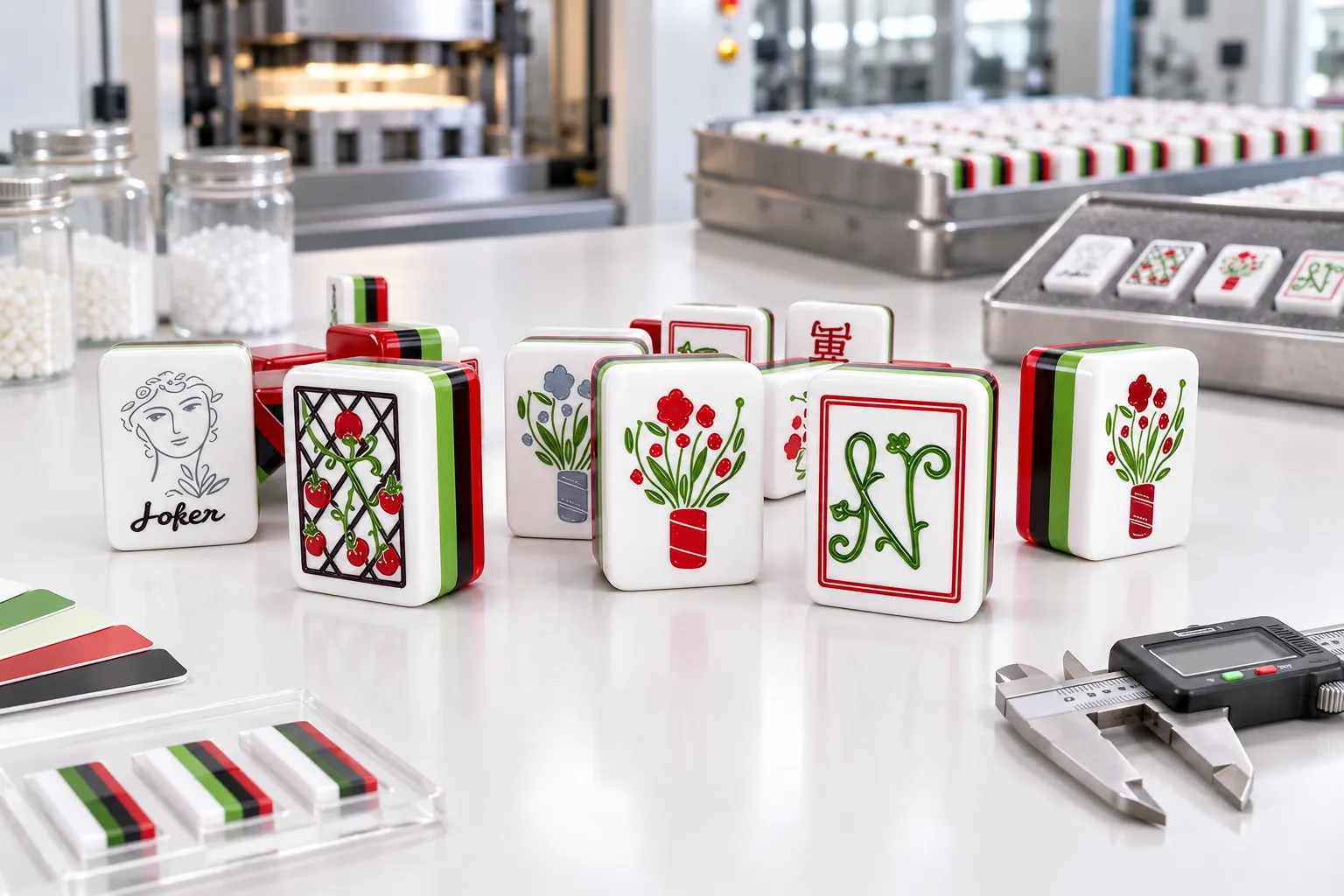
5. Inspect Production Equipment
Production equipment should match the product you are ordering.
Depending on the project, this may include equipment for:
- Cutting
- Molding
- Polishing
- UV printing
- Engraving
- Colour filling
- Packaging
Ask which production steps are performed internally.
If key processes are outsourced, ask how the supplier manages quality at the subcontractor.
6. Review Material Sourcing
Material consistency has a direct effect on production quality.
Ask:
- Where are raw materials purchased?
- Are the same suppliers used for repeat orders?
- Are incoming materials inspected?
- How are different material batches recorded?
For acrylic Mahjong products, batch differences may affect:
- Colour
- Transparency
- Texture
- Surface finish
Material control should therefore be part of every Mahjong supplier audit.
7. Check Incoming Material Inspection
Quality control should begin before production.
Ask whether the supplier inspects incoming:
- Acrylic
- Resin
- Melamine
- Packaging paper
- Boxes
- Hardware
- Accessories
Poor raw materials cannot always be corrected later.
A supplier that checks materials before production can reduce avoidable defects.
8. Review Artwork Management
Custom Mahjong projects often involve multiple artwork versions.
Ask how the supplier manages:
- File names
- Revisions
- Approval records
- Final production files
There should be a clear final version.
For example:
Artwork V4 – Approved for Mass Production
This reduces the risk of an outdated design being used.
Artwork control is an important part of a professional Mahjong supplier audit.
9. Check Colour Control Procedures
Colour is one of the most common areas of variation.
Ask whether the supplier uses:
- Pantone references
- Physical samples
- Material swatches
- Approved golden samples
Screen images alone are usually not enough for colour approval.
For branded products, make sure tile and packaging colours are controlled separately.
10. Review First-Piece Inspection
Before full production begins, the supplier should ideally inspect the first finished pieces.
This can help confirm:
- Tile dimensions
- Artwork position
- Printing quality
- Engraving
- Colour
- Surface finish
If there is a problem, it is much cheaper to correct it before thousands of pieces are produced.
11. Review In-Process Quality Control
A strong Mahjong supplier audit should look at what happens during production, not only at the final inspection.
Ask whether QC checks are performed:
- At the beginning
- During production
- Before packing
In-process checks can identify problems before they affect the entire batch.
12. Review Final Inspection Procedures
Before goods are packed for shipment, the factory should inspect finished sets.
Final QC may include:
- Tile quantity
- Tile dimensions
- Printing
- Engraving
- Surface finish
- Accessories
- Packaging
- Labels
Ask whether inspection results are recorded.
For larger orders, random sampling across multiple cartons is preferable to checking only one box.
13. Check Production Capacity
A supplier may produce excellent samples but struggle with large-volume orders.
Ask:
- Monthly capacity
- Current production load
- Maximum order size
- Typical repeat-order volume
Production capacity should match your current and future needs.
If your brand grows quickly, you do not want to restart supplier development after the first order.
14. Review Lead-Time Management
Ask the supplier to separate lead times into stages.
For example:
- Artwork approval
- Sample development
- Sample revision
- Material preparation
- Bulk production
- Packaging
- Final inspection
- Shipping preparation
A detailed timeline is more useful than simply saying “30 days.”
This is especially important for seasonal products or planned retail launches.
15. Check Packaging Capability
Packaging should be part of the Mahjong supplier audit if the product will be sold under your brand.
Review capability for:
- Standard boxes
- Custom boxes
- Magnetic boxes
- Carrying cases
- Inserts
- Printed sleeves
- Barcodes
- Product labels
Also check whether packaging is produced internally or by another supplier.
16. Inspect the Packing Area
The packing area can reveal a lot about production management.
Look for:
- Clean work areas
- Correct SKU separation
- Clear carton labels
- Protected finished products
- Organized accessories
Poor packing control can cause:
- Mixed colours
- Missing accessories
- Wrong packaging
- Incorrect labels
For multi-SKU orders, clear separation is especially important.
17. Check Warehouse Organization
A supplier’s warehouse should ideally separate:
- Raw materials
- Work in progress
- Finished goods
- Packaging
- Rejected products
Good organization reduces the risk of mixing products or using incorrect materials.
During a remote Mahjong supplier audit, ask the supplier to show the warehouse during a live video call.
18. Review Defect Handling
Ask what happens when defective products are found.
For example:
- Are defective tiles separated?
- Are they repaired or replaced?
- Are defect reasons recorded?
- Is the production process adjusted?
A supplier should not simply mix questionable pieces back into the finished order.
19. Ask About Quality Tolerances
No manufacturing process is completely variation-free.
Ask whether the supplier has acceptable tolerances for:
- Tile dimensions
- Weight
- Colour
- Printing position
- Engraving depth
Clear tolerances make quality discussions more objective.
They also help prevent disagreements after production.
20. Check Repeat-Order Consistency
Repeat orders are important for growing brands.
Ask whether the supplier retains:
- Artwork files
- Colour references
- Material specifications
- Packaging files
- Approved samples
This information helps future orders match previous production.
Repeat-order control should be included in a serious Mahjong supplier audit.
21. Review Private-Label Experience
If you are building your own Mahjong brand, ask whether the supplier has experience with:
- Logo printing
- Branded packaging
- Custom inserts
- Retail labels
- Barcodes
- SKU systems
Private-label production requires more coordination than simply buying an existing design.
22. Check Documentation
Professional suppliers should be able to prepare clear documents.
These may include:
- Quotations
- Proforma invoices
- Commercial invoices
- Packing lists
- Product specifications
- Carton information
Good documentation can make international shipping and warehouse receiving easier.
23. Review Export Experience
Ask which countries the supplier normally exports to.
Export experience can help with:
- Packing requirements
- Freight preparation
- Documentation
- Customs coordination
A supplier does not need experience in every country, but they should understand basic international shipping procedures.
24. Check Carton Information
Before shipment, the supplier should be able to provide:
- Carton quantity
- Units per carton
- Carton dimensions
- Gross weight
- Net weight
- Total CBM
This information helps buyers compare freight options and estimate landed cost.
25. Check Retail-Ready Labeling
For retail products, ask whether the supplier can apply:
- SKU labels
- Barcodes
- Country-of-origin marks
- Product labels
- Carton labels
Labels should be included in the sample or packaging approval whenever possible.
This reduces errors during final packing.
26. Evaluate Communication
Communication quality is also part of a Mahjong supplier audit.
Pay attention to:
- Response speed
- Clear answers
- Understanding of specifications
- Ability to explain production issues
- Willingness to provide evidence
A supplier who communicates clearly during development is easier to work with if problems arise later.
27. Review Payment Information Carefully
Before sending a deposit, confirm:
- Beneficiary company name
- Bank account details
- Invoice information
- Payment terms
Unexpected changes to payment instructions should always be verified directly.
Do not rely only on a forwarded email if bank details suddenly change.
28. Remote Mahjong Supplier Audit vs On-Site Audit
Not every buyer can visit a factory in person.
A remote Mahjong supplier audit can still be useful.
Ask for a live video showing:
- Factory entrance
- Production area
- Equipment
- QC area
- Packing area
- Warehouse
- Sample room
A live walkthrough is usually more informative than a collection of pre-recorded promotional videos.
For larger orders, an independent third-party factory audit or inspection may also be considered.
29. Red Flags During a Mahjong Supplier Audit
Be cautious if a supplier:
- Refuses live factory video
- Cannot explain production processes
- Avoids showing QC
- Gives inconsistent company information
- Cannot confirm materials
- Changes lead times repeatedly
- Provides vague specifications
- Avoids written approvals
One warning sign does not always mean the supplier is unsuitable.
However, several combined warning signs deserve closer attention.
Mahjong Supplier Audit Checklist
Before paying a bulk-production deposit, review:
- Company information
- Factory or trading-company status
- American Mahjong experience
- Sample quality
- Production equipment
- Material sourcing
- Incoming QC
- Artwork control
- Colour control
- First-piece inspection
- In-process QC
- Final inspection
- Production capacity
- Lead times
- Packaging capability
- Warehouse organization
- Defect handling
- Quality tolerances
- Repeat-order records
- Private-label capability
- Export documentation
- Shipping preparation
- Payment information
- Communication
A standardized Mahjong supplier audit checklist makes it easier to compare multiple factories using the same criteria.
Final Thoughts
A good sample is important, but it does not tell you everything about a supplier.
A complete Mahjong supplier audit helps buyers understand how the factory manages materials, production, quality, packaging and repeat orders.
For small test orders, a simple remote review may be enough.
For larger or more complex private-label projects, a more detailed supplier audit can reduce production and financial risk before the deposit is paid.
The goal is not to find a perfect factory.
The goal is to find a supplier with clear processes, reliable communication and the ability to reproduce your approved product consistently.
Planning a Custom Mahjong Order?
HUHU Mahjong supports retailers, distributors and brands with custom American Mahjong sets, wholesale production, OEM manufacturing and private-label packaging.
If you are carrying out a Mahjong supplier audit, you can send us your product specifications, artwork, target quantity and packaging requirements for evaluation.
About the Author
HUHU Team
We share industry insights, product knowledge, and manufacturing updates to help global clients better understand mahjong production and OEM solutions.