OEM/ODM MANUFACTURING FOR GLOBAL BRANDS
- View Our Alibaba Store
- info@huhumahjong.com
- +86 13326907761
Mahjong AQL Inspection Guide: How Wholesale Buyers Check Bulk Order Quality

When ordering American mahjong sets in bulk, product quality is one of the most important concerns for retailers, distributors, and private label brands. Even when a product looks excellent in a sample, buyers need confidence that the finished production order meets their approved specifications.
A wholesale shipment may contain hundreds or thousands of mahjong sets. Checking every individual component can require considerable time and resources, which is why some businesses use sampling-based quality inspection methods.
This is where mahjong AQL inspection becomes relevant.
AQL, or Acceptance Quality Limit, is used within established acceptance sampling systems to help buyers and suppliers evaluate production lots using defined inspection procedures.
For wholesale mahjong buyers, an appropriate inspection plan can help identify manufacturing defects, verify product consistency, and support purchasing decisions before goods are shipped.
This guide explains mahjong AQL inspection, how sampling works, which product details should be checked, and how to communicate quality requirements to your manufacturer.
What Is Mahjong AQL Inspection?
Mahjong AQL inspection is a quality evaluation approach in which a defined sample of products is selected from a production lot and checked against agreed acceptance criteria.
Rather than inspecting every mahjong set in an order, an inspector examines a specified number of units.
The inspection results are then assessed according to the agreed sampling plan.
The international standard ISO 2859-1:2026 describes sampling procedures indexed by Acceptance Quality Limit for inspection by attributes.
These procedures can be used to evaluate manufactured products and other items through structured sampling.
For American mahjong sets, inspection may cover tile dimensions, surface appearance, artwork quality, colour consistency, accessories, packaging, and product completeness.
However, AQL is not a universal guarantee that every item in a shipment is free from defects.
It is a statistical acceptance sampling approach that involves defined risks and agreed inspection rules.
Understanding this distinction is essential for wholesale buyers.
Why Mahjong AQL Inspection Matters for Wholesale Orders
A small defect may have little effect on one product, but repeated problems across a large shipment can create significant costs.
For example, a retailer may receive mahjong sets with inconsistent tile colours, missing accessories, or damaged carrying cases.
If these problems are not identified before shipment, the buyer may face customer complaints, returns, additional handling, or replacement costs.
Mahjong AQL inspection helps businesses establish a more structured approach to reviewing finished products.
It can also create clearer communication between buyers and manufacturers.
When both parties agree on the inspection scope and acceptance criteria, there is less uncertainty about what should be checked.
For private label brands, this is particularly important because products often include unique artwork and customised specifications.
A tile that looks acceptable in a standard collection may not meet the approved requirements of a premium custom design.
Inspection expectations should therefore match the product being manufactured.
How AQL Sampling Works for Mahjong Sets
AQL sampling follows an agreed inspection procedure rather than simply checking a random number of products chosen without a plan.
The appropriate inspection arrangement depends on several factors, including the lot size, inspection level, sampling scheme, and acceptance quality limit.
An inspector selects units according to the applicable method and evaluates them against the approved specification.
The inspection results are then used to determine whether the lot meets the agreed acceptance criteria.
Understanding the Inspection Lot
An inspection lot is the defined quantity of goods being evaluated.
For example, a buyer might have an order containing 500 identical American mahjong sets.
Those sets may form one inspection lot if they meet the agreed conditions for lot formation.
However, orders containing substantially different designs, materials, or production specifications may require separate inspection arrangements.
The lot definition should be agreed before inspection begins.
Selecting the Sample
Under a recognised sampling plan, the sample size is determined by the relevant tables and conditions.
It should not be selected simply because checking a certain number of boxes seems convenient.
The inspector then evaluates the selected units for specified nonconformities.
Making the Acceptance Decision
An acceptance sampling plan includes criteria for deciding whether the results support accepting or rejecting the lot.
The acceptable number of nonconforming units depends on the selected plan.
For mahjong AQL inspection, buyers should agree on the sampling method before production is completed.
The applicable standard and inspection criteria should also be stated clearly in the purchase agreement or quality specification.
Understanding Critical, Major, and Minor Mahjong Defects
Before inspecting a wholesale mahjong order, buyers need to determine which defects matter most.
A useful approach is to classify defects according to their severity.
These categories should be defined by the buyer and supplier, taking account of the product’s intended use and relevant safety requirements.
Critical Defects
Critical defects are generally associated with unacceptable safety risks or other serious nonconformities.
For example, a component presenting a significant safety hazard may be classified as critical.
The exact classification depends on the product, applicable regulations, and agreed inspection criteria.
Critical defects should receive particular attention rather than being treated as ordinary cosmetic issues.
Major Defects
Major defects can affect the product’s functionality, usability, or commercial acceptability.
Examples might include missing essential tiles, incorrect tile dimensions, or a carrying case that cannot close properly.
For a custom American mahjong set, significantly incorrect artwork may also be classified as a major defect if it fails to meet the approved product specification.
Minor Defects
Minor defects are typically less significant imperfections that do not substantially affect the product’s intended use.
Examples may include small cosmetic inconsistencies within defined tolerances.
However, what qualifies as minor can depend on the product’s positioning.
A minor appearance issue for an entry-level collection may be unacceptable for a premium product with strict finishing requirements.
This is why mahjong AQL inspection should use clear, product-specific definitions rather than vague descriptions.
Mahjong AQL Inspection for Tile Dimensions and Materials
Tile dimensions and material consistency are important quality characteristics.
American mahjong sets may use different tile sizes and materials depending on the product design.
The finished tiles should be compared with the approved specifications.
Checking Tile Dimensions
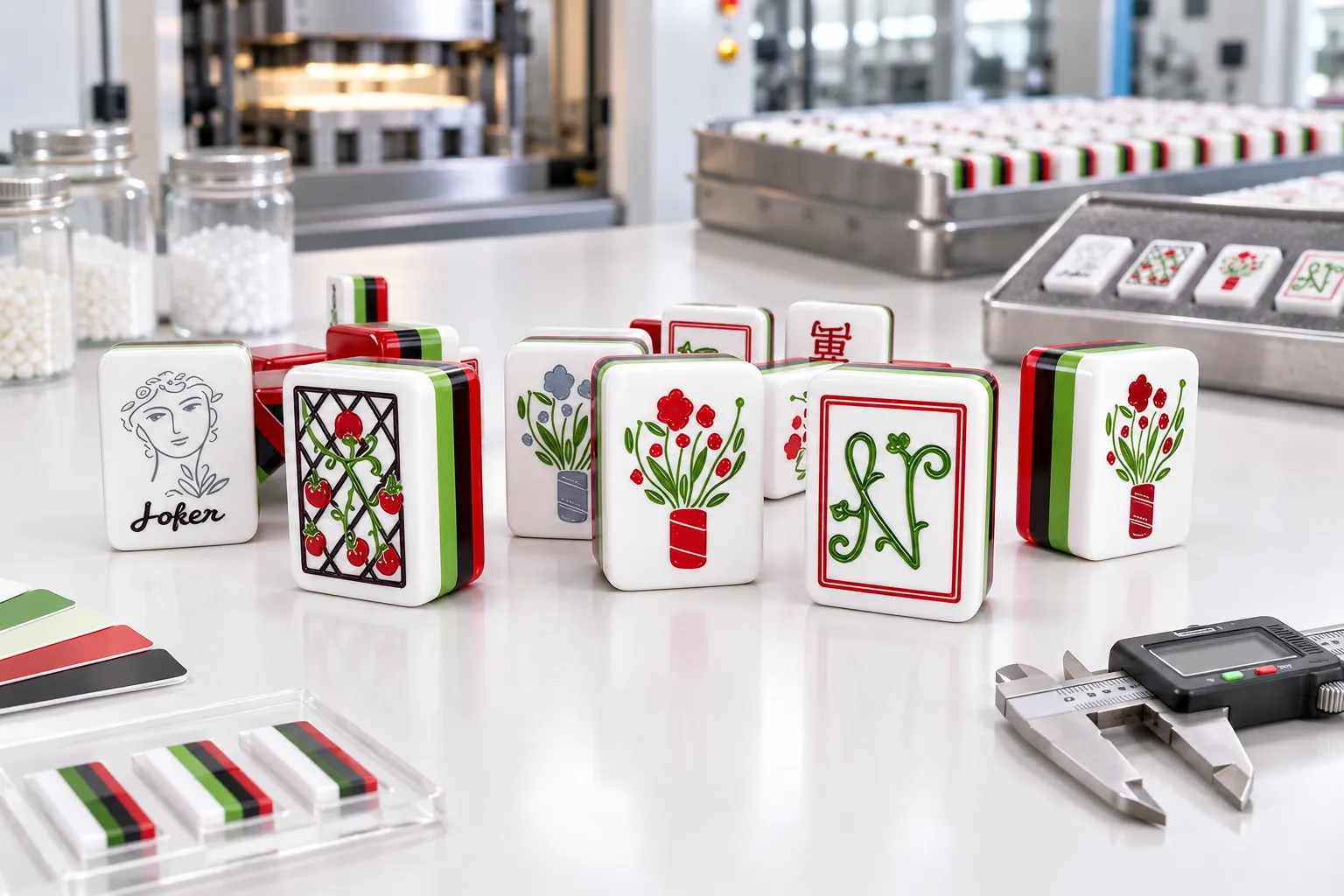
Inspectors may measure selected tiles to verify their height, width, and thickness.
Dimensions should remain within the tolerances agreed between the buyer and manufacturer.
For example, if a brand has approved a particular tile specification, the inspection should determine whether the finished products conform to that specification.
Inconsistent dimensions can affect tile alignment, handling, and compatibility with racks.
Checking Tile Material
The material should match the confirmed product specification.
Depending on the set, this may involve acrylic, melamine, or another material.
Buyers should not rely only on visual appearance when material verification is important.
Material identity may require supporting records or suitable testing beyond a routine visual inspection.
Reviewing Tile Weight and Feel
Weight and surface finish can influence the playing experience.
If these characteristics form part of the agreed specification, the inspection plan should explain how they will be evaluated.
Consistent physical characteristics are especially important for private label collections.
Checking Artwork and Colour During Mahjong AQL Inspection
Custom artwork is one of the defining features of many American mahjong collections.
Retailers may commission unique Joker illustrations, Flower designs, decorative symbols, and backing colours.
These details should be checked against the approved production sample.
Printed Artwork Accuracy
Inspectors should review whether the tile artwork matches the final approved design.
Useful checks may include symbol positioning, print clarity, missing details, and visible printing defects.
For a custom collection, the approved artwork files should be available as inspection references.
Colour Consistency
Colour differences can occur because of materials, production processes, or lighting conditions.
Buyers should therefore agree on acceptable colour tolerances before manufacturing.
If Pantone or other colour references are used, the inspection should follow the agreed comparison method.
A slight colour difference does not automatically mean that a product fails inspection.
The decision depends on the approved specification and tolerance.
Surface Finish
Tile surfaces should be reviewed for scratches, chips, stains, or other relevant defects.
Inspection criteria may differ between glossy, matte, and textured finishes.
For mahjong AQL inspection, clearly defining the allowable appearance standards helps avoid disagreements after production.
Checking Mahjong Tile Quantity and Product Completeness
A complete American mahjong set contains many individual components.
Incorrect quantities can create problems for the end customer, even when the individual tiles are manufactured correctly.
Inspection should therefore include checking the contents of sampled sets.
Depending on the product specification, the inspector may verify the required tile quantity and distribution.
Jokers, Flowers, Winds, Dragons, and numbered tiles should be checked against the approved configuration.
The inspection should also confirm any accessories included in the order.
For example, a product may contain racks, pushers, dice, chips, or an instruction booklet.
The exact components vary by set and should be confirmed in the purchase order.
Mahjong AQL inspection can include product completeness checks, but buyers may also require additional counting or verification procedures for particularly important components.
A sampling plan should not be assumed to replace every other necessary quality control activity.
Inspecting Mahjong Racks, Pushers, and Accessories
Accessories contribute to the overall customer experience.
Even when the tiles are excellent, damaged or poorly fitting accessories can affect the value of the finished product.
Mahjong Racks
Racks should be checked for relevant dimensional and functional requirements.
Inspectors may review whether the rack holds tiles securely and whether its construction matches the agreed design.
Pushers
Pushers should be compatible with the intended rack system where compatibility is part of the product specification.
The inspection may include basic functionality and visible finishing quality.
Dice and Other Components
Dice and smaller accessories should be checked for quantity, appearance, and any applicable specification.
If a product includes custom accessories, these should be inspected against the approved reference.
For wholesale buyers, mahjong AQL inspection should consider the entire retail-ready product rather than only the main tile set.
Packaging Quality Control for Wholesale Mahjong Orders
Packaging is another important part of product inspection.
A beautiful mahjong set may still create problems if it arrives with damaged packaging or missing labels.
Retailers should confirm that the packaging matches the agreed specification.
Inspection may cover retail box quality, carrying case construction, printed artwork, internal protection, and product labels.
For custom gift boxes, buyers may want to check colour consistency, logo placement, printing alignment, and box condition.
Shipping cartons should also be evaluated against the agreed packing instructions.
However, packaging performance may require additional testing beyond visual inspection.
Mahjong AQL inspection should therefore be part of a broader quality assurance plan that considers both the product and its transportation requirements.
How to Prepare a Mahjong AQL Inspection Checklist
Before an order reaches final inspection, the buyer should prepare clear quality requirements.
A good checklist helps the inspector understand what is expected.
For a standard American mahjong set, the checklist may include tile dimensions, material, tile count, artwork, surface finish, and accessories.
For a private label order, the checklist may also include custom colours, logo placement, unique tile designs, and branded packaging.
The buyer should identify which characteristics are most important and how nonconformities will be classified.
It is also useful to provide approved samples and production records.
When creating a mahjong AQL inspection checklist, avoid relying on general descriptions such as “high quality” or “perfect appearance.”
Instead, specify measurable or clearly observable requirements whenever possible.
This makes the inspection process more consistent.
When Should Mahjong AQL Inspection Take Place?
Inspection timing can affect how useful the results are.
Some buyers choose to inspect products during production, while others arrange final inspection before shipment.
Pre-Production Review
Before mass production, buyers should confirm the approved artwork, materials, product dimensions, and packaging requirements.
For customised products, a sample approval process can help establish the expected quality standard.
During-Production Inspection
During-production checks may help identify certain problems while manufacturing is still underway.
For example, inconsistent colours or incorrect artwork may be easier to address before the entire order is completed.
However, the appropriate inspection stage depends on the manufacturing process.
Final Pre-Shipment Inspection
Final inspection is often performed when the goods are sufficiently completed and available for examination.
The inspector checks the selected sample and records the findings.
If the inspection identifies unacceptable problems, the buyer and supplier should review the agreed corrective action process.
For mahjong AQL inspection, the timing and sampling conditions should be defined before the inspection is arranged.
What Happens If a Mahjong Order Fails Inspection?
A failed inspection does not automatically mean that an entire shipment must be discarded.
The appropriate next step depends on the findings, contract terms, and available corrective actions.
For example, the manufacturer may need to identify the cause of the problem and determine whether affected products can be repaired, replaced, or reworked.
In some cases, additional inspection may be necessary.
The buyer should review the inspection report and agree on the next steps before authorising shipment.
It is important to document any corrective actions.
If products are reworked, the buyer may request verification that the problems have been addressed.
Mahjong AQL inspection provides information for acceptance decisions, but the commercial response to a failed lot should follow the agreed purchasing and quality arrangements.
Can Third-Party Inspectors Check Mahjong Wholesale Orders?
Some wholesale buyers prefer to arrange an independent inspection.
A third-party inspector can evaluate finished goods against the buyer’s agreed specifications.
This may be useful when the buyer cannot visit the factory personally.
However, an inspection company still needs clear product requirements.
Without approved samples, defect definitions, and appropriate acceptance criteria, even an experienced inspector may struggle to assess a custom mahjong product consistently.
Buyers should confirm the inspector’s experience, inspection scope, sampling method, and reporting format.
The inspection report should identify the findings clearly and include supporting photographs or measurements when appropriate.
Third-party mahjong AQL inspection can provide an additional layer of independent verification, but it does not eliminate all manufacturing or supply-chain risks.
AQL Inspection vs 100% Product Inspection
AQL sampling and 100% inspection are not the same process.
AQL sampling evaluates selected units according to a specified acceptance plan.
A 100% inspection attempts to check every item or every specified characteristic within the defined inspection scope.
Both approaches have limitations.
Sampling inspection involves statistical risk because not every product is examined.
Full inspection can require more resources and may still miss some defects, depending on the method and execution.
For mahjong wholesale orders, the appropriate approach depends on the product, defect severity, production conditions, and buyer requirements.
Some businesses combine different forms of inspection.
For example, selected characteristics may be checked through sampling, while other important checks are performed more extensively.
When planning mahjong AQL inspection, buyers should discuss which methods are appropriate rather than assuming that one procedure will address every possible issue.
How to Discuss Quality Requirements With a Mahjong Manufacturer
Clear communication with the manufacturer is essential.
Before placing an order, buyers should explain their expected quality standards and the product characteristics that matter most.
For custom American mahjong sets, this may involve approved tile artwork, material specifications, dimensions, colours, accessories, and packaging.
Buyers should also confirm whether an AQL-based inspection plan will be used.
If so, the sampling standard, inspection level, defect classifications, and acceptance limits should be agreed in writing.
At HUHU Mahjong, OEM and ODM manufacturing services cover custom design, material selection, production, packaging, and quality control.
Our OEM and Custom Mahjong Services provide information about developing branded American mahjong products.
You can also explore our Case Studies to see examples of private label mahjong manufacturing projects.
For specific inspection arrangements, buyers should confirm the available options directly with the manufacturing team.
Common Mahjong AQL Inspection Mistakes to Avoid
One common mistake is choosing an AQL value without understanding the associated sampling plan.
An AQL figure alone does not define a complete inspection procedure.
Another mistake is failing to agree on defect classifications.
If the buyer considers a visible colour difference unacceptable but the supplier treats it as a minor variation, disagreements may arise.
Buyers should also avoid using outdated artwork or unapproved samples as inspection references.
For private label collections, even small design changes can affect whether the finished product meets expectations.
Another issue is assuming that sampling guarantees zero defects.
AQL acceptance sampling involves probabilities and statistical risks.
Finally, buyers should not leave inspection arrangements until the shipment is already packed and ready to leave.
Good mahjong AQL inspection begins with clear specifications and quality expectations before mass production.
Frequently Asked Questions About Mahjong AQL Inspection
What does AQL mean in mahjong quality inspection?
AQL stands for Acceptance Quality Limit. It is used in defined sampling systems to evaluate production lots according to agreed acceptance criteria.
Is mahjong AQL inspection required for every wholesale order?
Not necessarily. The appropriate inspection method depends on the buyer, supplier, product requirements, contract terms, and applicable regulations.
Does passing AQL inspection mean every mahjong set is perfect?
No. Sampling inspection does not examine every unit, and acceptance does not guarantee that the entire lot is free from defects.
What defects should mahjong buyers check?
Common inspection characteristics include tile dimensions, material, artwork, colour consistency, surface finish, tile count, accessories, packaging, and product functionality.
Can mahjong AQL inspection be used for custom designs?
Yes, an agreed sampling plan can be used to inspect customised products. However, approved artwork, colour references, and clear defect criteria are particularly important.
What happens if the inspection results are unacceptable?
The buyer and supplier should review the findings and determine the appropriate corrective actions under their agreement. These may include rework, replacement, further inspection, or other negotiated solutions.
Can buyers request a third-party mahjong inspection?
Yes. Independent inspection services may be arranged, subject to supplier access, scheduling, inspection scope, and the agreed commercial terms.
Which standard covers AQL sampling inspection?
ISO 2859-1:2026 specifies sampling schemes indexed by Acceptance Quality Limit for lot-by-lot inspection by attributes.
Final Thoughts on Mahjong AQL Inspection
Mahjong AQL inspection can be a useful part of quality management for businesses purchasing American mahjong sets in wholesale quantities.
It provides a structured approach to evaluating selected products against agreed quality requirements.
However, sampling inspection should not be treated as a substitute for clear product specifications, approved samples, production controls, and supplier communication.
For retailers and private label brands, effective quality assurance begins before manufacturing.
By confirming artwork, materials, tile dimensions, accessories, packaging, and acceptance criteria early, buyers can reduce uncertainty during final inspection.
A well-planned mahjong AQL inspection process can support more informed purchasing decisions and better communication between buyers and manufacturers.
Looking for an American mahjong manufacturer for standard or custom wholesale orders?
Explore HUHU Mahjong’s OEM and Custom Services or contact our team to discuss your design specifications, inspection requirements, order quantities, and manufacturing plans.
About the Author
HUHU Team
We share industry insights, product knowledge, and manufacturing updates to help global clients better understand mahjong production and OEM solutions.