
OEM/ODM MANUFACTURING FOR GLOBAL BRANDS
- View Our Alibaba Store
- info@huhumahjong.com
- +86 13326907761
Mahjong Batch Traceability: A Practical Guide for Wholesale Buyers and Private Label Brands
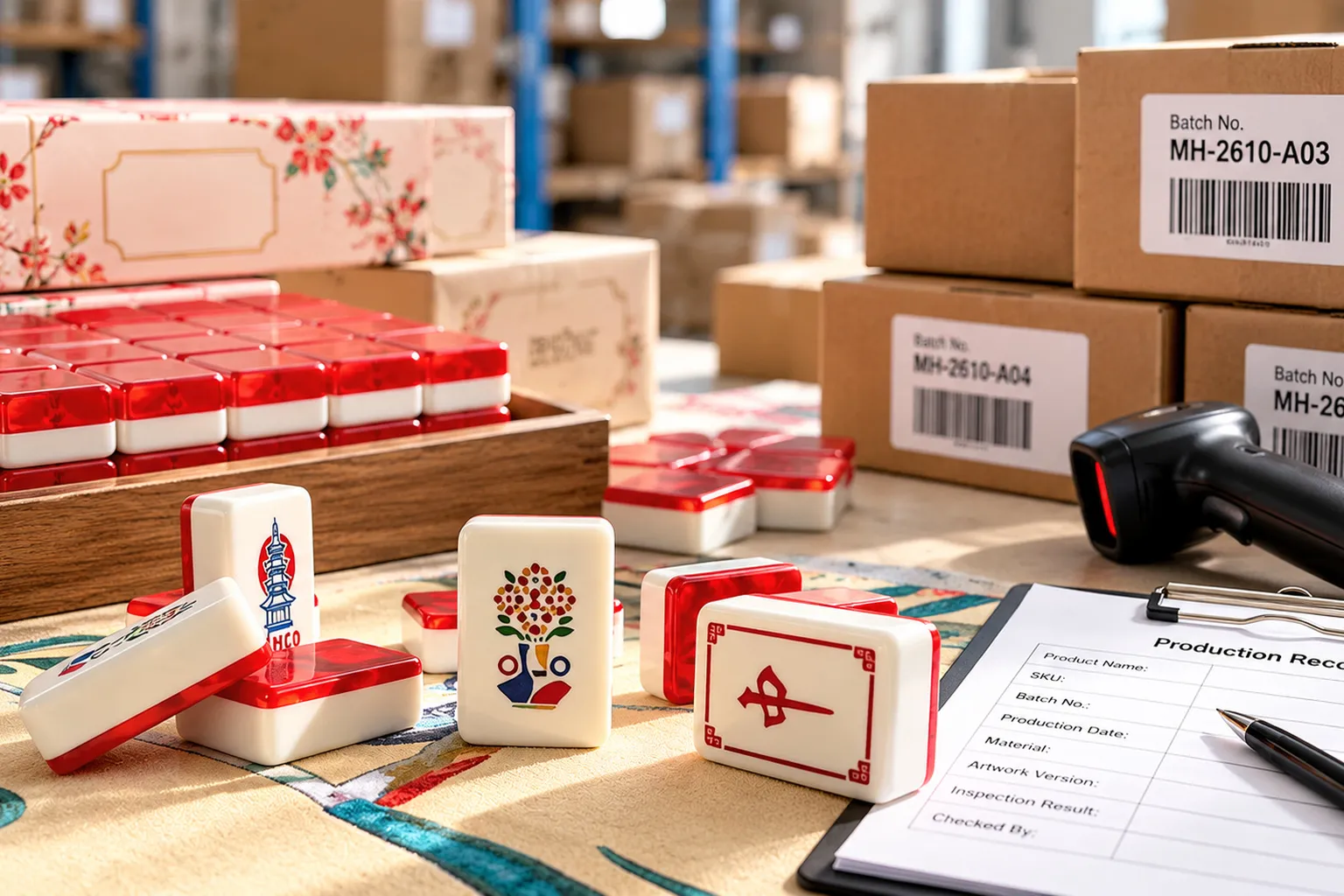
When purchasing American mahjong sets in bulk, buyers usually focus on product design, materials, pricing, and delivery schedules. However, another important consideration is how products can be identified and tracked after manufacturing.
A retailer may receive several shipments of the same mahjong collection over the course of a year. Although the products appear identical, they may have been manufactured at different times or using different material batches.
If a quality issue is discovered, identifying the affected products can become difficult without accurate records.
This is where mahjong batch traceability becomes valuable.
A practical traceability system helps manufacturers, importers, and retailers connect finished products with relevant production records. It can support quality investigations, inventory management, and communication between suppliers and buyers.
For private label brands selling custom American mahjong sets, mahjong batch traceability can also help maintain product consistency across different manufacturing orders.
This guide explains how batch identification works, which records wholesale buyers should consider, and how to develop a more organised approach to product tracking.
What Is Mahjong Batch Traceability?
Mahjong batch traceability refers to the ability to identify a group of mahjong products and connect it with relevant manufacturing, inspection, and distribution information.
A batch, sometimes called a lot, is a defined group of products associated with particular production conditions or records.
For example, a manufacturer might produce 500 American mahjong sets using one approved artwork specification and a particular production schedule.
These products could be assigned a batch reference that distinguishes them from another production run.
The exact method depends on the manufacturer’s traceability system.
According to the GS1 Global Traceability Standard, businesses can identify products at different levels, including product, batch or lot, and individual-item levels.
For wholesale mahjong products, the appropriate identification level depends on the business’s requirements.
Mahjong batch traceability does not necessarily mean assigning a unique serial number to every tile.
Instead, the aim is to maintain enough information to identify products and investigate relevant issues when necessary.
Why Mahjong Batch Traceability Matters for Wholesale Orders
Wholesale orders often involve significant quantities of products.
A retailer purchasing several hundred mahjong sets may distribute them across multiple stores, warehouses, or online sales channels.
Once products enter the supply chain, identifying where individual shipments came from becomes more complicated.
Mahjong batch traceability can help businesses keep these records organised.
It is particularly useful when a manufacturer produces repeated orders of the same design.
For example, a retailer may order one collection in January and place another order several months later.
Although both shipments use the same product artwork, the manufacturing dates and production records may be different.
Batch identification helps distinguish the two orders.
This can make it easier to review customer complaints, compare production quality, and communicate with suppliers.
Understanding Batch Numbers for American Mahjong Sets
A batch number is an identifier assigned to a defined group of products.
It may contain letters, numbers, or a combination of both.
The format is determined by the manufacturer’s internal system or an agreed business requirement.
For example, a hypothetical batch reference could be:
MH-2610-A03
This might represent a mahjong product group manufactured during a particular period.
However, the meaning of each character would need to be defined by the business using the system.
There is no universal requirement for mahjong manufacturers to use this exact format.
For mahjong batch traceability, consistency is more important than creating a complicated identification code.
A useful batch reference should be recorded accurately and connected to the appropriate production information.
What Production Information Should Be Recorded?
A traceability system is only useful when batch references connect to meaningful information.
For wholesale American mahjong sets, relevant records may include production dates, product specifications, materials, and quality inspection results.
The appropriate level of detail depends on the manufacturer’s processes and the buyer’s requirements.
Product Name and SKU
Each batch should be associated with the correct product.
A retailer selling several mahjong collections may use separate SKUs for different designs, colours, or packaging configurations.
A product code helps distinguish one collection from another.
However, a SKU and a batch number serve different purposes.
The SKU identifies the product variation, while the batch number identifies a defined group of products.
Production Date
Recording the production period helps establish when a batch was manufactured.
This information can be useful when comparing different production runs.
It may also help identify products affected by a particular manufacturing issue.
Material Specifications
American mahjong sets can use different materials, colours, and surface finishes.
Maintaining records of the approved material specification helps support consistency.
Where appropriate, a manufacturer may also retain information about relevant material batches.
Artwork Version
For custom American mahjong sets, artwork version control is particularly important.
A private label brand may update its Joker designs, decorative patterns, or printed details between production runs.
Connecting the approved artwork version to the batch record can help prevent confusion.
Quality Inspection Records
Relevant quality inspection results may also be associated with the production batch.
These can provide useful information when investigating a customer complaint.
Effective mahjong batch traceability therefore depends on accurate product and manufacturing documentation, not simply printing a code on a carton.
Mahjong Batch Traceability for Custom and Private Label Products
Private label brands often develop products with distinctive artwork, colours, and accessories.
These custom specifications make product identification particularly important.
For example, a brand may sell a floral American mahjong collection featuring ivory tile faces, lavender backs, and customised Joker artwork.
Later, the brand may introduce a revised version with a slightly different colour or updated packaging.
If the two versions are stored together without clear identification, warehouse and fulfilment teams may accidentally mix them.
Mahjong batch traceability can help distinguish the production runs and their specifications.
For private label brands, useful records may include the approved sample, final artwork files, material references, packaging specifications, and batch identification.
At HUHU Mahjong, we support OEM and ODM manufacturing for businesses developing standard and customised American mahjong products.
Our OEM and Custom Mahjong Services cover design development, material selection, production, and packaging options.
Buyers who require particular production records or identification methods should confirm these requirements before placing an order.
How Batch Tracking Supports Mahjong Quality Control
Quality inspection and batch traceability are related, but they are not the same thing.
Quality inspection evaluates whether products meet agreed specifications.
Batch traceability helps identify the products associated with particular manufacturing records.
When used together, these processes can support more effective quality management.
For example, suppose a retailer reports that several mahjong sets have a similar printing issue.
If the affected products can be connected to a particular batch, the supplier may be able to investigate the production records associated with that group.
This may help determine whether the issue is limited to one production run or requires a broader review.
Without batch information, the investigation may require more extensive checking.
However, mahjong batch traceability does not prevent defects by itself.
It should be supported by appropriate manufacturing controls, approved specifications, and quality inspections.
Using Batch Records to Investigate Customer Complaints
Customer feedback can reveal issues that were not apparent during manufacturing or final inspection.
For example, a customer might report a tile surface defect, a colour inconsistency, or a missing accessory.
The retailer should first gather details about the affected product.
Useful information may include the order number, product SKU, photographs, and available batch reference.
The retailer can then communicate the information to the supplier.
If the manufacturer maintains corresponding production records, the investigation may become more focused.
For mahjong batch traceability, a clear link between customer orders and inventory records is especially valuable.
It can help retailers understand which products were supplied and when.
This is useful for businesses handling repeated orders of the same collection.
How to Connect Mahjong Batches With Shipping Records
Manufacturing traceability becomes more useful when it continues through packaging and distribution.
A batch reference may be recorded on shipping documents, internal inventory records, or carton labels.
The exact method depends on the supplier’s system and the buyer’s requirements.
For example, a wholesale order may contain products from more than one production batch.
If this happens, the buyer may want the packing records to distinguish the quantities associated with each batch.
This can make warehouse receiving and inventory management easier.
Mahjong batch traceability should also account for situations where a shipment is divided between different destinations.
If the same batch is delivered to several warehouses, distribution records can help identify where the products were sent.
These records are particularly useful for brands operating multiple retail channels.
Batch Identification on Retail Packaging
Not every consumer product requires a visible batch number on its retail packaging.
Whether batch identification is necessary depends on applicable regulations, retailer requirements, and the business’s chosen traceability procedures.
For some mahjong products, internal inventory records may provide sufficient identification for the agreed purpose.
For others, a small batch code on the packaging may be useful.
The appropriate approach should be discussed before packaging artwork is approved.
If a batch reference is printed on a box or label, it should be placed where it can be read without interfering with the product’s presentation.
For mahjong batch traceability, the code must also correspond accurately to the manufacturer’s records.
A printed code has limited value if the associated information cannot be retrieved.
Managing Different Mahjong Production Batches in a Warehouse
Warehouse organisation plays an important role in maintaining traceability.
A retailer receiving several shipments of American mahjong sets may need to distinguish older stock from newer products.
This is particularly relevant if the brand has updated its artwork or packaging.
Products can be organised using SKUs, batch references, receiving dates, and inventory locations.
For example, two batches of the same floral mahjong collection may be stored separately until their specifications have been confirmed.
Retailers should also consider how their order fulfilment process records which products are shipped to customers.
Mahjong batch traceability becomes more useful when information can be followed beyond warehouse receiving.
Businesses do not necessarily need a complex system at the beginning.
Smaller retailers may start with accurate spreadsheets and consistent stock records.
As operations grow, inventory management software may provide additional support.
Traceability for Repeat Mahjong Wholesale Orders
Repeat orders are common for successful American mahjong collections.
A retailer may reorder the same design several times throughout the year.
Although the product specification remains consistent, each production run may have different manufacturing records.
Mahjong batch traceability helps keep these orders distinguishable.
This can be particularly helpful when comparing product quality across different deliveries.
For example, if customers report differences between two shipments, the retailer may be able to identify the relevant batches.
The manufacturer can then review the associated production records and approved specifications.
Maintaining clear records also helps businesses coordinate future product updates.
If a brand decides to change a tile colour or carrying case, it can identify which production version introduced the change.
How Mahjong Batch Traceability Helps Manage Product Changes
Product designs can evolve over time.
A brand may update its tile artwork, introduce a new packaging design, or change an accessory.
These modifications should be documented clearly.
For example, imagine a retailer sells an American mahjong set with a green carrying case.
A later production order uses an updated case design.
The brand may want to distinguish the earlier product from the revised version.
A new SKU may be appropriate when the change creates a distinct trade item.
Batch identification can provide additional manufacturing information within each product version.
For mahjong batch traceability, buyers should confirm how product changes are recorded and communicated.
This is particularly important when different versions may remain in circulation at the same time.
What Should Wholesale Buyers Ask Their Mahjong Manufacturer?
Before placing a bulk order, buyers can discuss traceability expectations with the manufacturer.
The level of documentation required will depend on the project.
A retailer purchasing standard products may have relatively simple needs.
A larger private label brand managing multiple collections may require more detailed records.
Useful questions include whether the manufacturer assigns production batch references and which information is associated with them.
Buyers may also ask how approved artwork versions are documented and whether inspection records can be connected to particular production runs.
For international shipments, it can be useful to confirm how batch information appears in packing records.
When planning mahjong batch traceability, these expectations should be agreed before production rather than introduced after a problem occurs.
HUHU Mahjong outlines its manufacturing workflow on our Production Process page, including design confirmation, material selection, sample development, production, and quality control.
Specific traceability arrangements should be confirmed with our team for each project.
Common Mahjong Batch Traceability Mistakes
One common mistake is confusing a product SKU with a batch number.
A SKU identifies a product variation, while a batch reference identifies a particular group of products.
Both may be useful, but they provide different information.
Another mistake is using batch codes without maintaining supporting records.
If a code cannot be connected to production information, it may not help during an investigation.
Retailers may also lose track of batch information when goods are transferred between warehouses.
This can make it difficult to identify products later.
Another issue occurs when product designs change but the updated specifications are not clearly documented.
For private label products, this can result in confusion between different manufacturing versions.
Good mahjong batch traceability depends on consistent procedures and accurate information throughout the supply chain.
Do Small Mahjong Retailers Need Batch Tracking?
A small retailer may not need the same traceability system as a large distributor.
However, basic product records can still be valuable.
For example, keeping the supplier’s order reference, receiving date, product code, and available batch information can help with future customer enquiries.
As the business grows, additional tracking may become useful.
A retailer carrying one standard collection may have straightforward requirements.
A business selling several custom designs across multiple locations may need more detailed procedures.
Mahjong batch traceability should be proportionate to the business’s product range, operational risks, and applicable requirements.
The goal is to create useful records without adding unnecessary complexity.
Frequently Asked Questions About Mahjong Batch Traceability
What is mahjong batch traceability?
Mahjong batch traceability is the ability to identify groups of mahjong products and connect them with relevant manufacturing, inspection, and distribution information.
Do wholesale mahjong sets need batch numbers?
Not necessarily. The need for batch identification depends on applicable regulations, retailer requirements, and the traceability procedures agreed between the buyer and supplier.
Is a batch number the same as a SKU?
No. A SKU generally identifies a product variation, while a batch number identifies a defined group of products associated with production records.
Can mahjong batch traceability help with quality complaints?
Yes. Batch information may help retailers and manufacturers identify affected products and review the relevant production records.
Is mahjong batch traceability useful for custom designs?
Yes. Custom products may have different artwork versions, colours, and materials. Batch records can help distinguish manufacturing runs and support product consistency.
Should batch numbers appear on retail packaging?
That depends on the product, market, and business requirements. Some businesses use visible packaging codes, while others maintain identification through internal records.
Can small mahjong retailers use a spreadsheet for batch tracking?
Yes. A spreadsheet may be a practical starting point if it is maintained accurately and records the information needed for the business’s traceability objectives.
How can manufacturers support mahjong batch traceability?
Manufacturers can discuss available production identification methods, documentation, inspection records, and product version control. The exact services should be agreed before production.
Final Thoughts on Mahjong Batch Traceability
Mahjong batch traceability is a practical consideration for businesses purchasing American mahjong sets in wholesale quantities.
As retailers expand their collections and place repeat orders, accurate product records become increasingly valuable.
Batch identification can help connect products with manufacturing information, support quality investigations, and improve communication between buyers and suppliers.
For private label brands, it can also assist with managing artwork updates, material specifications, and different production versions.
However, effective mahjong batch traceability requires more than assigning a code. It depends on consistent documentation and clear procedures across manufacturing, inventory, and distribution.
By discussing traceability expectations early, wholesale buyers can build a more organised approach to managing their mahjong products.
Looking for an OEM manufacturer for standard or custom American mahjong sets?
Explore HUHU Mahjong’s OEM and Custom Services or contact our team to discuss product specifications, production documentation, and wholesale order requirements.
About the Author
HUHU Team
We share industry insights, product knowledge, and manufacturing updates to help global clients better understand mahjong production and OEM solutions.