
OEM/ODM MANUFACTURING FOR GLOBAL BRANDS
- View Our Alibaba Store
- info@huhumahjong.com
- +86 13326907761
Mahjong Tile Sizes Explained: American vs Chinese vs Japanese Riichi
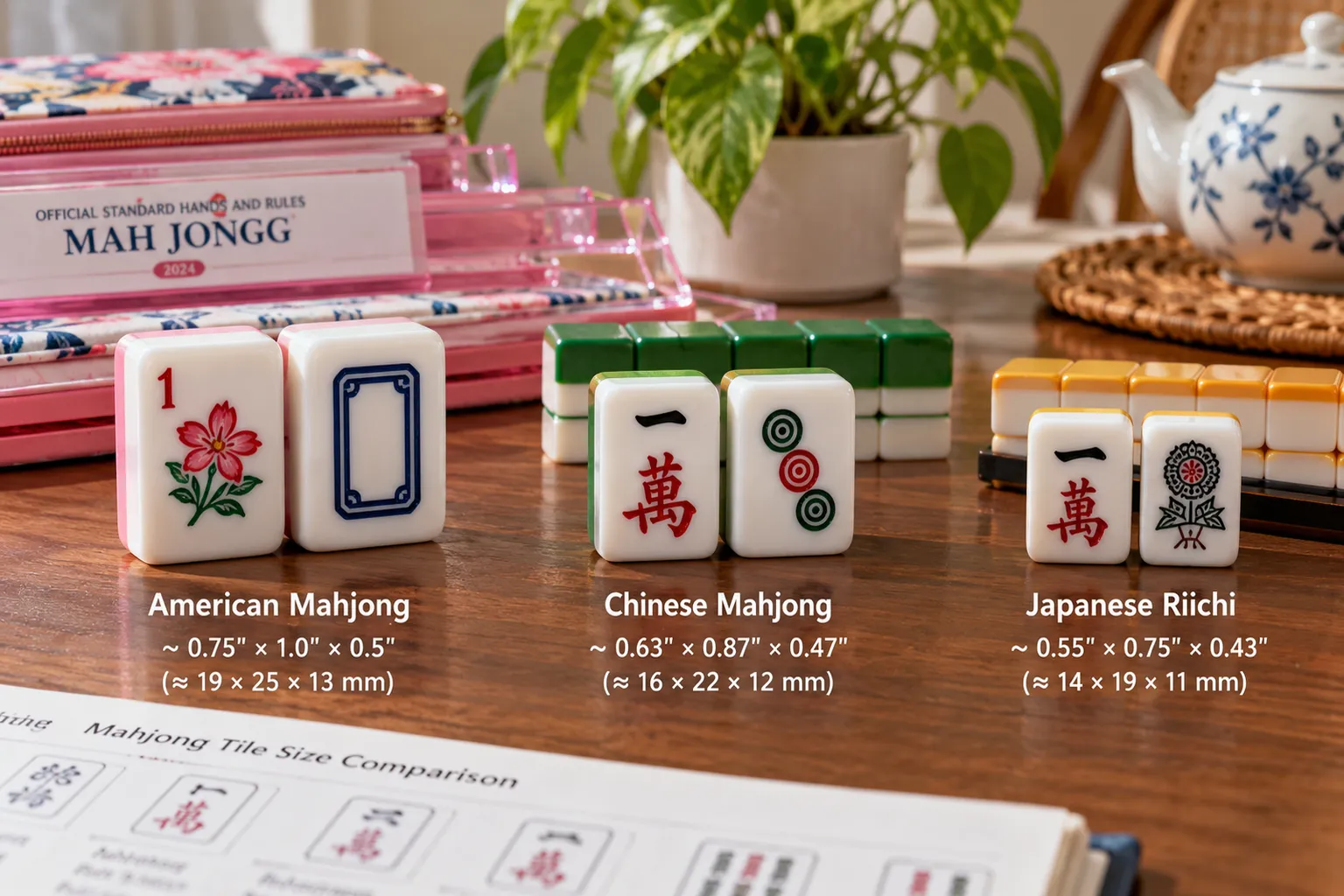
Mahjong tile sizes are one of the most overlooked details in wholesale and custom orders, yet they decide how a set feels in the hand, whether it fits its racks, how much it weighs in the carton and who will want to buy it. A set that looks perfect in a photo can disappoint if the tiles are too small to read or too large for the rack.
This guide explains mahjong tile sizes for the three most common styles: American, Chinese and Japanese Riichi. You will learn the typical dimensions, how tile size affects cost and shipping, and what retailers, distributors and private-label brands should specify before approving a sample.
Why Mahjong Tile Sizes Matter for Wholesale Buyers
When buyers compare suppliers, they usually look at design, material and price first. Mahjong tile sizes tend to come later, often after a sample arrives and something feels wrong. Getting them right early saves time and avoids costly changes.
Tile size affects several things at once:
- Playability: larger tiles are easier to read and handle, while smaller tiles feel compact and neat.
- Compatibility: American sets must match their racks and pushers, and Riichi tiles may need to suit automatic tables.
- Weight and portability: bigger tiles add weight to the set, the case and the shipping carton.
- Customer fit: older players often prefer larger tiles, while travel buyers want something small.
- Positioning: a full-size set and a mini travel set are different products with different prices.
In short, mahjong tile sizes are a product decision, not just a technical specification.
Mahjong Tile Sizes by Style: A Quick Overview
The three main styles use different mahjong tile sizes because each developed in its own market with its own habits. They also use different tile counts. A traditional Chinese set has 144 tiles, an American set has 152 tiles including eight jokers, and a Japanese Riichi set has 136 tiles because it leaves out the flower and season tiles.
Because of these differences, sets are not always interchangeable. A tile that works well for one style may be too small, too large or simply missing the pieces another style needs.
American Mahjong Tile Sizes
A commonly sold full-size American tile measures about 1-3/16 inches high, 7/8 inch wide and 1/2 inch thick, which is roughly 30 × 22 × 13 mm. Many modern American sets list almost the same dimensions, around 30 × 23 × 13 mm.
American mahjong tile sizes also include a few variations worth knowing about:
- Full-size sets are the standard choice for home play and retail.
- Large-number sets use the same basic size but print bigger characters for easier reading.
- Mini sets can be as small as about 0.8 × 0.5 × 0.4 inches (around 20 × 13 × 10 mm). They are popular for travel and gifts, though tiles this small can be harder to read.
Many retail American sets include 166 tiles, with spare jokers and blanks on top of the standard 152. Racks are part of the game, so the tile size has to match the rack. Some sets, for example, are designed to fit 18.5-inch racks.
Chinese Mahjong Tile Sizes
Chinese sets generally use larger tiles than Japanese ones, and the range is wide. Consumer sets with tiles around 29 × 22 × 12 mm exist, and so do sets with tiles about 34 mm tall. On the open market, tile height has been reported to range from roughly 20 mm to 50 mm.
For competition, the World Mahjong Organization adopted a standard in 2011: tiles used in official play should be between 32 mm and 42 mm tall. This is a useful reference point if you are developing a premium or tournament-style Chinese set.
Chinese tiles are often designed to stand upright and to feel substantial, so thickness and weight matter as much as height.
Japanese Riichi Mahjong Tile Sizes
Riichi tiles are usually smaller in height than Chinese tiles but relatively thick, which helps them stand well on the table. A standard Japanese tile is commonly described as about 26 mm high, 20 mm wide and 16 mm thick, weighing around 15 grams.
Riichi mahjong tile sizes are often grouped into classes:
- Small: around 25 × 18 × 16 mm
- Standard: around 27 × 20 × 16 mm
- Large: around 30 × 22 × 17 mm
Japanese tiles are often made to work with automatic mahjong tables, which is one reason tile dimensions are controlled so tightly in this style. You may also see even larger classes such as 2L and 3L in specialist shops. If your customers use automatic tables, confirm the exact tile dimensions before you place an order.
Standard, Large and Mini: Understanding Mahjong Tile Size Categories
Rather than a single “standard”, the market really works with size categories. Understanding them helps you build a range that covers different customers.
Standard or full-size tiles are the safe core of any collection. They suit most players and work with most racks, trays and mats.
Large or XL tiles are a strong upgrade for players who want easier reading and a heavier, more premium feel. They also look impressive in gift sets, but they make the set heavier and may need bigger cases.
Mini or travel tiles are the right choice for portable sets, small gifts and promotional items. They save weight and space, but readability becomes a trade-off, so artwork and engraving must be especially clear.
When you plan your range, remember that mahjong tile sizes can be used as a way to separate product tiers, such as a standard home set, a large premium set and a mini travel set.
Mahjong Tile Sizes and Racks: Why Compatibility Matters
American mahjong needs racks, and the rack length and slot width are built around a specific tile size. If your tiles are slightly larger than the rack allows, they will not sit properly. If they are much smaller, they will look lost in the slots.
This is why tile size and rack design should be developed together. When you change one, check the other. The same is true for pushers, trays and carrying cases: a small difference in tile thickness can change how the whole set closes inside its box.
For Chinese and Riichi sets, which usually do not rely on long racks, the equivalent check is the tray, the case and the mat. Make sure your final mahjong tile sizes fit the accessories you plan to sell with them. Our Regional Mahjong Sets & Accessories range is built around this idea of coordinated components.
How Mahjong Tile Sizes Affect Cost, Weight and Shipping
Even a few millimetres matter when you multiply them across hundreds of sets. Larger mahjong tile sizes generally mean:
- More material per tile, which can raise production cost
- Higher set weight, which affects freight and courier charges
- Larger cases and cartons, which reduce how many sets fit in each box or container
- More packaging material to keep the tiles protected
Smaller mahjong tile sizes work the other way. They reduce weight and make cartons more efficient, which is attractive for travel sets and promotional products. If you are planning shipping, read our guide on mahjong carton packing for wholesale orders to see how size and packing work together.
The practical lesson is to decide your tile size before you design the case and the carton, not after.
Which Mahjong Tile Sizes Suit Which Customers?
There is no single best size. The right choice depends on who will buy and use the set.
- Home players and families: full-size tiles are the safest option, since they work for most people and most rules.
- Older players: large tiles with large numbers are easier to read and handle, so they are a good fit for this group.
- Gift buyers: premium full-size or large sets in a well-designed case create a strong first impression.
- Travellers and casual players: mini or compact sets reduce weight and fit in a bag.
- Clubs and tournament players: tiles that match the standards of the style they play are the priority.
- Hotels, cafés and event businesses: durable full-size tiles that are easy to read from a distance work best.
For a deeper look at building a range around customer types, see our guide to building a mahjong wholesale product assortment.
Custom Mahjong Tile Sizes: What Brands Should Specify
If you are creating a private-label or custom collection, you do not have to accept a generic size. Custom tile sizes, materials and colours are all part of OEM and ODM production. To avoid misunderstandings, give your manufacturer a clear brief:
- Height, width and thickness of the tile, in millimetres
- The mahjong style you are targeting: American, Chinese or Riichi
- Total tile count, including jokers, flowers and spares
- Rack, tray or table compatibility, with exact rack dimensions if needed
- Material, because acrylic, melamine and other materials feel different at the same size
- Target tile weight, if you have a particular feel in mind
- Packaging constraints, such as a case that must fit a certain shelf or box size
Learn more about what you can adjust in our guide to custom American Mahjong sets and what can be customized, or explore our OEM / Custom service.
A Seven-Point Checklist for Approving Mahjong Tile Sizes
Before you approve a sample or release bulk production, run through this list:
- Measure the height, width and thickness of several tiles, not just one.
- Check consistency across the set so that all tiles match.
- Test the fit with racks, trays, pushers or tables.
- Check readability of numbers, characters and jokers at the chosen size.
- Weigh the full set and confirm it suits your price point and shipping plan.
- Close the case to confirm the tiles fit with their packaging and any accessories.
- Get the final size in writing so that bulk production matches the approved sample.
Our guides to sample approval and the mahjong quality control checklist explain how to apply these checks across a full order.
How Huhu Mahjong Supports Custom Mahjong Tile Sizes
Huhu Mahjong is a factory-direct manufacturer with more than 12 years of experience in OEM, ODM and OBM mahjong production. We support custom tile sizes, materials, colours and branded packaging, with sampling in as little as 7–10 days for standard samples so you can check the size and feel before committing to bulk production.
If you already know your target dimensions, send them with your inquiry. If you are still deciding, tell us your market, your customer type and your price range, and our team can recommend a size and set configuration that fits. You can browse our Standard Household Mahjong Tiles Series and Travel & Portable Mahjong Set Series for reference, then contact us for a quote.
Frequently Asked Questions
What are the standard mahjong tile sizes?
There is no single standard, because mahjong tile sizes depend on the style. A full-size American tile is about 30 × 22 × 13 mm, a standard Japanese Riichi tile is about 26–27 × 20 × 16 mm, and Chinese tiles are often larger, with height commonly ranging from around 29 mm to over 34 mm.
Are American and Chinese mahjong tile sizes the same?
No. They are similar in some sets, but Chinese tiles vary widely and are often larger or thicker. The two styles also use different tile counts and rules, so the sets are not always interchangeable.
What size are Japanese Riichi mahjong tiles?
A standard Riichi tile is commonly about 26 mm high, 20 mm wide and 16 mm thick. Smaller and larger classes exist, and some sizes are designed for automatic tables.
What mahjong tile sizes are best for travel sets?
Mini tiles, such as the roughly 20 × 13 × 10 mm size used in some American travel sets, are light and compact. Just make sure the engraving and artwork stay easy to read at that size.
Can I customize mahjong tile sizes for my brand?
Yes. Custom tile size is part of OEM and ODM production. Provide the target dimensions, mahjong style, tile count and any rack or case requirements, and approve a sample before bulk production.
Do larger tiles cost more to ship?
Usually, yes. Larger tiles add weight and often need larger cases and cartons, which can raise freight cost per set.
Final Thoughts
Mahjong tile sizes shape the player’s experience, the product’s price position and the cost of getting it to your customer. Whether you are building a standard home range, a premium gift collection or a compact travel set, decide your tile size early, confirm it against racks and packaging, and approve it in writing at the sample stage.
Ready to develop your next set? Send your target mahjong tile sizes, style and quantity to our team, and we will reply within 24 hours with pricing and recommendations.
Note: the dimensions in this article are typical ranges reported across the industry and vary by manufacturer. Always confirm exact tile sizes with your supplier before ordering.
Sources: Yellow Mountain Imports – Japanese Riichi Mahjong set specifications · Majandofu – Mahjong tile sizes in Japanese riichi mahjong · Desertcart – Riichi tile size comparison · Yellow Mountain Imports – Chinese Mahjong set · China Daily – World Mahjong Organization standard tile height · ShopSavvy – American mahjong tile dimensions · ShopSavvy – Mini American mahjong dimensions · I Love Mahj – American Mah Jongg tiles and quantities · The Mahjong – How to choose the right mahjong set
About the Author
HUHU Team
We share industry insights, product knowledge, and manufacturing updates to help global clients better understand mahjong production and OEM solutions.