
OEM/ODM MANUFACTURING FOR GLOBAL BRANDS
- View Our Alibaba Store
- info@huhumahjong.com
- +86 13326907761
Mahjong Tile Artwork Guide: How to Prepare Files and Pantone Colours for Custom Sets
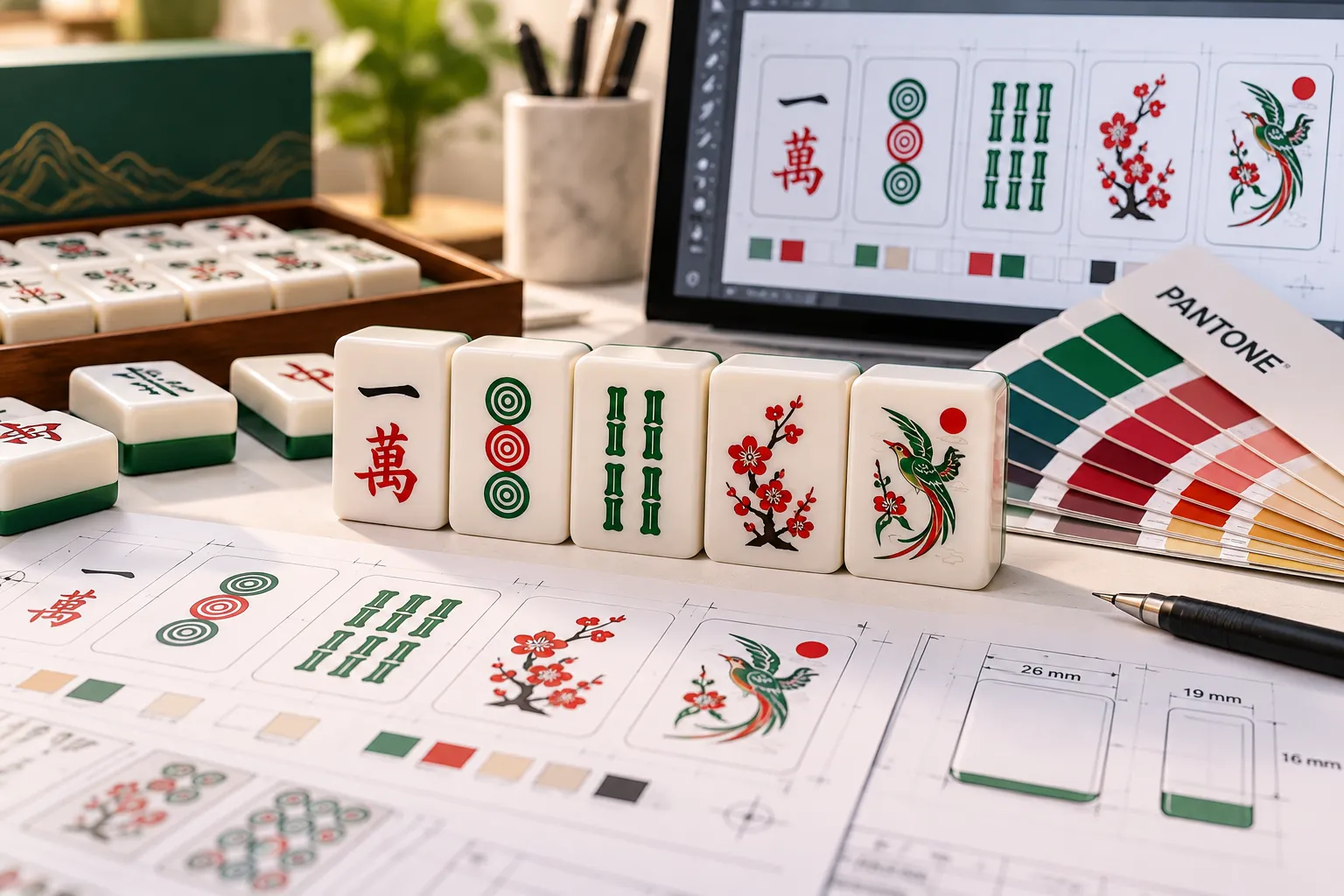
Mahjong tile artwork is where a custom set either looks exactly as imagined or ends up slightly off. A design that looks perfect on your screen can print darker, lighter or softer on a real tile, and a logo that looks sharp in a presentation can come out blurry on a small tile face. Most of these problems are not factory mistakes. They come from artwork files that were not prepared for production.
This guide explains how to prepare mahjong tile artwork for a custom or private label order. It covers file formats, colour setup, Pantone references, layout checks and the approval steps that protect your design before bulk production begins.
Why Mahjong Tile Artwork Needs Extra Care
A mahjong set has many small surfaces, and every one of them is seen up close. Tile faces, tile backs, racks, cases and packaging all carry your design, and players handle them for hours. Small flaws that go unnoticed on a poster become obvious on a tile.
Good mahjong tile artwork has to do three jobs at once. It has to look attractive, stay easy to read during play, and stay consistent across every tile in the set. That last point matters most for wholesale orders. If the colour or line weight drifts between batches, customers notice. Our guide to bulk production consistency explains why a clear, approved reference matters from the very first sample.
What a Factory Needs From Your Mahjong Tile Artwork
Before you send anything, it helps to know what the production team actually needs. For most custom projects, a complete artwork package includes:
- The tile face designs, with each tile type clearly identified
- The tile back design and any pattern or colour reference
- Your logo files, if the logo appears on tiles, racks, cases or packaging
- Colour references, ideally Pantone codes
- Notes on material, finish and any special effects
- Any packaging artwork that must match the set
If you do not have finished files, you do not have to start from nothing. Many manufacturers, including Huhu Mahjong, offer design assistance for tile artwork, logos and patterns, so you can begin with a concept and refine it with the production team. Our guide to what buyers need to prepare before production covers the wider checklist.
Best File Formats for Mahjong Tile Artwork
File format decides how much control the factory has over your design. As a general rule, send vector files whenever you can.
- Vector files (AI, EPS, SVG, or a vector PDF): these keep lines and shapes sharp at any size. They are the best choice for logos, borders, icons and flat colour designs.
- High-resolution raster files (PNG, TIFF, or a high-resolution PDF): these are fine for detailed or painterly designs, as long as the resolution is high enough for the printed size.
- Layered working files (PSD or layered AI): useful if the team may need to adjust colours or move elements.
Avoid sending screenshots, compressed social media images or low-resolution files. They look fine on a phone, but they lose detail when enlarged to production size. Also send the original file whenever possible, not only an exported preview.
Vector or Raster: Which Should You Use?
The right choice depends on the design.
Use vector for logos, geometric patterns, line art, text and simple illustrations. Edges stay crisp, and colours are easy to specify exactly.
Use raster for watercolour effects, photographic textures, soft gradients and richly shaded artwork. If you work in raster, ask your supplier for the exact tile face dimensions and work at the final size or larger, so nothing has to be stretched.
Many designs combine both. A common approach is a raster background with vector logo and text on top. If you are unsure, send both versions and note which parts should be treated as final.
How to Set Up Colours for Mahjong Tile Artwork
Colour is the most common source of surprises. Screens and printed tiles use different colour systems, so the same design can look different in each.
- RGB is used by screens. It can show very bright colours that print may not match exactly.
- CMYK is a printing colour model. Converting from RGB to CMYK often makes bright colours look a little duller.
- Pantone is a reference system that gives each colour a code, so everyone talks about the same colour.
For brand colours, ask your team for the Pantone codes and include them in your artwork notes. If you are choosing colours for the first time, a physical reference such as a Pantone colour guide helps you pick colours you can actually see, rather than relying on a monitor. If you only have a screen colour, send the hex or RGB value and note that it needs to be matched to a physical sample.
Why Colours Look Different on Acrylic and Melamine
The material under the colour changes how it looks. This is why a design cannot be judged only from a file.
On clear or layered acrylic, colours can shift because light passes through the layers. A deep colour may look richer, and a light colour may look different against a coloured or translucent back. Glossy and matte finishes also change how a colour reflects light. On melamine, the surface is more solid, so colours look flatter and more opaque.
If your design relies on a precise shade, tell your supplier which material you are using, and ask for a physical sample on that exact material. Our guide to mahjong tile materials explains how acrylic and melamine differ, and our article on UV printing for custom mahjong tiles covers how detailed artwork is printed.
Layout Checks for Mahjong Tile Artwork
Even beautiful mahjong tile artwork fails if players cannot read it. Before you send files, check the following.
- Readability: numbers, letters and symbols should be easy to read at a glance, from across the table and in evening light. Our guide to how to choose artwork that is easy to read explains why contrast matters.
- Size and margins: keep important elements away from the tile edges. Ask the factory for a template showing the exact printable area. Our guide to mahjong tile sizes explains how American, Chinese and Japanese tiles differ.
- Line weight: very thin lines can disappear in printing, especially on small tiles. Keep fine details bold enough to survive.
- Consistency: every tile of the same type should look identical, and every suit should follow the same style.
- Contrast: make sure suits and special tiles can be told apart quickly, including for players with weaker eyesight.
A simple test helps: print the design at actual size, hold it at arm’s length and see whether you can still read it.
Logos and Fonts in Mahjong Tile Artwork
If your logo appears on tiles, racks or cases, treat it as a separate asset.
- Send the logo as a vector file, and include a version in one solid colour.
- Provide clear space around the logo, so it is not crowded by other elements.
- Convert all fonts to outlines before sending. This prevents font substitution, which can change letter shapes if the factory does not have the same font installed.
- If the logo appears on packaging too, keep the version and colour consistent across the set. Our guide to mahjong packaging for wholesale and private label covers box and case options.
Small logos on tile faces need special care. If the logo is too detailed, it may not print clearly at that size. Ask for a simplified version if needed.
How to Name and Organise Your Mahjong Tile Artwork Files
Clear file organisation saves time and prevents mix-ups. A simple structure works well:
- One folder for tile faces, one for backs, one for logos and one for packaging
- Clear file names, such as the tile type and version number
- A single text file or document listing colours, materials and special notes
- A version number or date on every revision, so the latest file is obvious
Your files should also match what is written on your order. Our guide to preparing a mahjong purchase order explains how to keep specifications consistent. If you plan to add barcodes or SKU labels, see our article on mahjong product labeling for wholesale.
Approve a Physical Sample Before Bulk Production
No file review replaces a real sample. Once the artwork is ready, ask for a physical sample made on the actual material, with the actual finish.
When the sample arrives, check:
- Colour accuracy against your Pantone reference
- Print sharpness on small details and text
- Alignment of faces, backs and edges
- Readability under normal room lighting
- How the finished tiles look together as a set, not only one at a time
Approve the sample in writing, and keep it as the reference for bulk production. Our guide to sample approval is not part of this site, so use our own article on why samples matter before a custom order for the full process. After approval, a quality control inspection helps confirm that bulk production matches the sample.
Mahjong Tile Artwork Checklist
Use this list before you send your files:
- Vector files for logos and line art
- High-resolution files for detailed images
- Pantone codes for key colours
- Fonts converted to outlines
- Tile face, tile back and logo files clearly labelled
- Notes on material and finish
- Artwork checked at actual size for readability
- A request for a physical sample before bulk production
Common Mahjong Tile Artwork Mistakes
- Sending low-resolution or compressed images
- Relying on screen colours instead of Pantone references
- Forgetting that material and finish change how colours look
- Placing important details too close to the edge
- Using very thin lines or tiny text
- Leaving fonts as live text instead of outlines
- Changing the design after the sample is approved
- Not keeping an approved sample as a reference
For more on avoiding errors, read our list of custom mahjong order mistakes.
Mahjong Tile Artwork FAQ
What file format is best for mahjong tile artwork?
Vector files such as AI, EPS, SVG or a vector PDF are best for logos and line art. High-resolution PNG, TIFF or PDF files work for detailed images.
Do I need Pantone codes for custom mahjong tiles?
They are strongly recommended for brand colours. If you do not have them, send a clear colour reference and ask for a sample to confirm the match.
Can you help if I do not have finished artwork?
Many suppliers can assist with design. Share your concept, colour ideas and target market, and the team can help turn them into production-ready files.
Why do my tile colours look different from my screen?
Screens use RGB light, while printed tiles use ink on a physical material. The material and finish also affect how colours appear, so always check a physical sample.
How many samples should I expect before approval?
It depends on the complexity of the design. Simple projects may need one round, while detailed or colour-sensitive designs may need adjustments.
Does mahjong tile artwork affect MOQ or lead time?
Custom artwork usually means custom sampling and production steps. See our guide to custom mahjong sets MOQ, sampling costs and lead times for details.
Final Thoughts on Mahjong Tile Artwork
Well-prepared mahjong tile artwork saves time, reduces revisions and protects the look of your brand. Send clean vector files, specify colours with Pantone references, check readability at actual size, and approve a physical sample before bulk production begins.
If you are planning a custom set, tell us your design idea, material, quantity and target market. We can review your mahjong tile artwork, suggest improvements and prepare samples. Contact Huhu Mahjong to get started, or explore our custom American mahjong options.
About the Author
HUHU Team
We share industry insights, product knowledge, and manufacturing updates to help global clients better understand mahjong production and OEM solutions.